


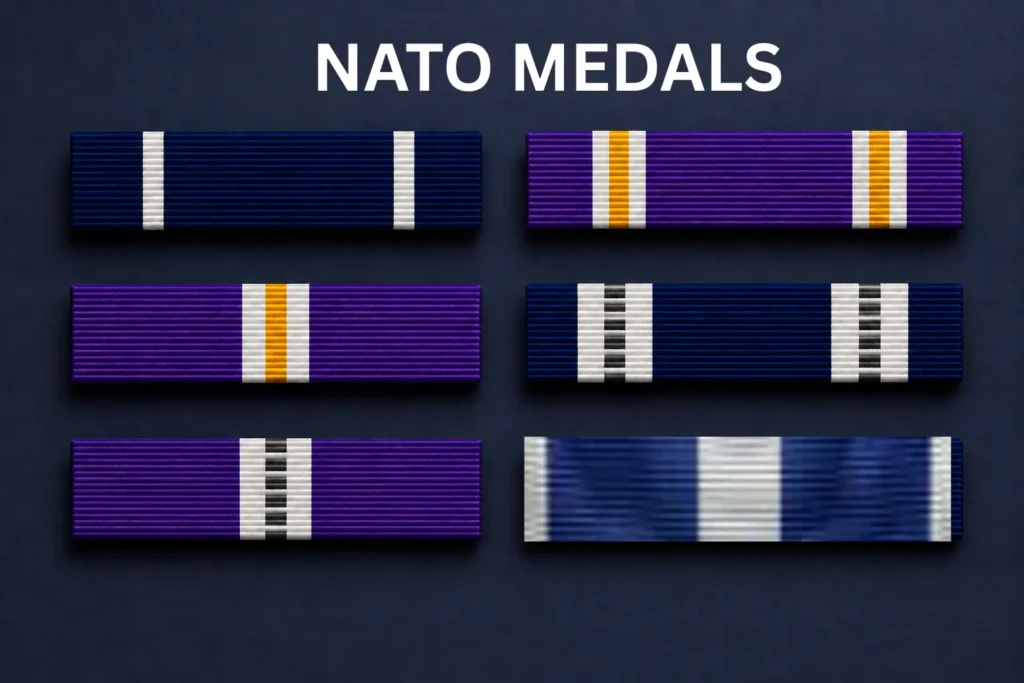
Of all the awards people ask us about, the NATO Medal produces more confusion than any other. Not because the rules are complicated, but because they are unusual, and because almost nothing about this award works the way another award works.
Veterans write to us saying they earned three NATO Medals, and naturally they cannot understand why the rules allow only one on the rack. Others ask why the bars they picked up in theater do not appear on the ribbon we sent them. Both questions have clear answers, and neither is anyone’s mistake.
Quick Answer: The NATO Medal is an international award, not a United States award. A U.S. service member may wear only one NATO Medal ribbon, and it must be the first one they received. Instead, bronze service stars on that first ribbon mark the additional NATO Medals you earned for other operations. Furthermore, U.S. regulations do not permit wearing the operation bars that NATO issues with the medal.
What Is the NATO Medal?
The North Atlantic Treaty Organization awards this medal, not the United States. In practice, it recognizes service in NATO-led operations, and it goes to personnel from many different countries serving under the same command.
That single fact, therefore, explains most of the confusion that follows. Because the award belongs to NATO rather than to the Department of Defense, NATO wrote its rules for an alliance of thirty-plus nations, each with its own uniform regulations. The United States then decides separately how its own people may accept and wear it.
So two rulebooks are in play. NATO decides who earns the medal. The United States decides how you wear it. However, they do not say the same thing, and the American rules are the stricter of the two.
Notably, Eekelers-Centini International manufactures the medals in Belgium, which is why the finish looks a little different from American-made awards sitting beside it on the same rack.
Why Does the NATO Medal Confuse So Many Veterans?
Four things trip people up, and it is worth naming them plainly before we work through each one.
You may wear only one, no matter how many you earned.
It has to be the first one, not the most recent, and not the one from the deployment that mattered most to you.
The operation bars are not authorized for wear by U.S. personnel, even though NATO issued them to you.
There is no single NATO Medal ribbon. Different operations carried different ribbon designs, particularly before 2003, so two veterans can both hold a NATO Medal and wear ribbons that look nothing alike.
None of that is anyone’s error. Rather, it is an award built for an alliance, worn under the rules of a single nation.
Which NATO Medals Are There?
More than most people realize. In fact, NATO has issued medals under two broad categories.
Article 5 medals cover operations under the collective defense clause of the North Atlantic Treaty, which treats an attack on one member as an attack on all.
Non-Article 5 medals cover everything else: peacekeeping, stabilization, training and humanitarian missions.
| Category | Operation | Period |
| Article 5 | Operation Eagle Assist | 2001 to 2002 |
| Article 5 | Operation Active Endeavour | 2001 to 2016 |
| Non-Article 5 | Former Yugoslavia | 1992 to 2002 |
| Non-Article 5 | Kosovo | 1998 to 2002 |
| Non-Article 5 | Macedonia | 2001 to 2002 |
| Non-Article 5 | Balkans | 2003 to present |
| Non-Article 5 | NTM-Iraq | 2004 to 2011 |
| Non-Article 5 | AMIS, Darfur | 2005 to 2007 |
| Non-Article 5 | Pakistan earthquake relief | 2005 to 2006 |
| Non-Article 5 | Africa | 2008 to present |
| Non-Article 5 | Operation Unified Protector, Libya | 2011 |
| Non-Article 5 | Operation Resolute Support, Afghanistan | 2015 to 2021 |
| Non-Article 5 | Operation Sea Guardian | 2016 to present |
| Non-Article 5 | NATO Mission Iraq | 2018 to present |
| Non-Article 5 | Vigilance Medal | 2022 to present |
A veteran of the Balkans in the nineties, Afghanistan in the 2010s, and a Mediterranean deployment in between may well have earned three of these. Even so, they will still wear one ribbon.
What Does the NATO Medal Ribbon Look Like?
Every NATO Medal ribbon shares one thing: a field of NATO blue, formally Reflex Blue on the Pantone Matching System. After that, they differ.
| Ribbon | Design |
| Former Yugoslavia | Blue with two thin white stripes on each side |
| Kosovo | Blue and white stripes with a wide white stripe at center |
| Macedonia | Blue and white with four white stripes |
| Eagle Assist | Blue with a thin gold center stripe framed in white |
| Active Endeavour | Blue with two thin gold stripes framed in white |
| Non-Article 5 Balkans | Blue with a silver center stripe framed in white |
| Non-Article 5, post-2003 operations | Blue with two silver stripes framed in white |
Before 2003, each operation had its own ribbon. In early 2003, NATO simplified matters down to three ribbon styles and began identifying the specific operation with a bar worn on the ribbon instead.
Therefore, that change is the source of our third confusion, and it deserves its own section.
Can You Wear the Operation Bars on a NATO Medal Ribbon?
No. Not on a United States uniform.
NATO issues operation bars so that a ribbon shared across many missions can still say which mission it represents. Indeed, soldiers from other member nations wear them routinely. United States Armed Forces regulations do not permit the wearing of operation bars on the NATO Medal ribbon.
So if you came home from a NATO deployment with a bar in the presentation case and you cannot find anywhere to put it, nothing has gone wrong. Instead, keep it with your papers or in a shadow box at home. In short, it does not go on the uniform here.
Frankly, this catches people out constantly, and we would rather explain it kindly than have you assume a vendor shortchanged you.
Can You Wear More Than One NATO Medal?
No, and this is the rule that surprises people most.
Current U.S. policy states it plainly: only the initial NATO medal awarded may be worn.
So a veteran holding three NATO Medals wears one ribbon on the rack. Not three of them, and not the newest either. Nor the one they are proudest of. Instead, they wear the very first one they received.
Of course, we know how that lands. A Kosovo deployment and an Afghanistan deployment under NATO command were two very different years of a life, and it feels wrong that only one shows. But the rule exists so that racks stay readable across an alliance where a dozen different medals could otherwise stack up, and the awards you earned are all still recorded in your service record whether or not they appear on the ribbon rack.
How Do Bronze Service Stars Work on the NATO Ribbon?
Meanwhile, this is how the other awards do show, and it is the part most people miss.
A bronze service star marks each subsequent NATO Medal awarded for a separate operation, and it goes on both the suspension ribbon of the medal and the service ribbon.
Here is a worked example, because it makes the rule far clearer than any description.
Suppose a Soldier served in Former Yugoslavia, then Kosovo, then in Afghanistan under ISAF. Three NATO Medals earned. What goes on the rack?
The Former Yugoslavia ribbon, because that was the first one received, with two bronze service stars on it. One star for Kosovo, one for Afghanistan.
| What you see | What it means |
| NATO ribbon, no device | One NATO Medal |
| NATO ribbon, one bronze star | Two NATO Medals |
| NATO ribbon, two bronze stars | Three NATO Medals |
| NATO ribbon, three bronze stars | Four NATO Medals |
In short, the stars carry the count, and the ribbon design records where you started. Read that way, the whole thing makes sense.
Where Does the NATO Medal Sit in the Order of Precedence?
Near the bottom of the rack, in the group of non-U.S. service awards. Importantly, that placement is not a judgment on the service. Rather, it is simply how American precedence handles awards from other nations and international bodies.
| Position | Award |
| Immediately before | United Nations Medal |
| The award | NATO Medal |
| Immediately after | Multinational Force and Observers Medal |
In every case, all U.S. decorations, unit awards, campaign medals and service medals sit above this group.
Each branch publishes its own complete list. See our guides for the Army, Navy, Air Force, Marine Corps, Coast Guard, and Space Force.
Who Is Eligible for the NATO Medal?
NATO sets eligibility, and it varies a little by operation, but the common standards are these.
Thirty days of service in the operation, either continuous or accumulated across separate periods.
Aircrew qualify differently. Specifically, one day of service counts for the first sortie flown on any day of the operation.
Because NATO sets these criteria and the operation commander certifies the service, your NATO Medal usually arrives through your chain of command rather than through your own service’s awards branch. That is also why it sometimes shows up in your record months after you get home.
Meanwhile, one related point is worth knowing. A NATO deployment often produces a U.S. award alongside the NATO Medal. Afghanistan service under ISAF or Resolute Support, for example, generally carries the Afghanistan Campaign Medal as well, and possibly the Global War on Terrorism Service Medal depending on dates and duties.
How to Check Your Own Record
Step one. Find your DD Form 214 if you have separated. Block 13 lists decorations, medals, badges and campaign ribbons, and NATO awards should appear there.
Step two. If you are still serving, ask your personnel office to pull your award history.
Step three. Identify which NATO Medal came first. That determines the ribbon design you wear. Check the dates rather than trusting memory, because deployments blur together.
Step four. Count the rest. Each additional NATO Medal for a separate operation is one bronze star.
Step five. Set the operation bars aside. They are yours and they are meaningful, but they belong in a display case rather than on the uniform.
If your record is unclear, or a NATO award never made it into your file, your personnel office can request a correction. It happens more often with alliance awards than with U.S. ones, simply because the paperwork crosses more desks.
Build Your Rack the Easy Way
Once you know which ribbon and how many stars, the rest should be straightforward.
Our ribbon rack builder arranges your awards in correct order of precedence for your branch and places devices for you, including the bronze stars on a NATO ribbon.
You can also browse by branch: Army, Navy, Air Force, Marine Corps, Coast Guard, and Space Force. Our full range of military medals is there as well.
Use code STR2025 for 10% off your order.
Built in the USA
We make every ribbon and rack right here in the United States. In addition, our ultra-thin profile sits flat against the coat and holds its line across every row.
Super Thin Ribbons is a U.S.-based company, headquartered at 1602 Loop 11, Wichita Falls, Texas 76306. You can reach our team directly at 940-851-6220 or sa***@**************ns.com.
If you are not sure which NATO ribbon you should be wearing, please call us before you order. This is the one award where a phone call saves the most trouble, and we are glad to help you work it out.
Frequently Asked Questions
No. U.S. policy permits only the first NATO Medal you received on the uniform. Instead, bronze service stars on that first ribbon mark any additional NATO Medals for separate operations.
The one for the first NATO Medal you received, regardless of which operation you consider most significant.
Each bronze service star represents one additional NATO Medal earned for a separate operation. Therefore, two stars means three NATO Medals in total.
Not on a U.S. uniform. NATO issues them and other member nations wear them, but United States regulations do not authorize them. Instead, keep yours in a display case.
Immediately after the United Nations Medal and immediately before the Multinational Force and Observers Medal, within the non-U.S. service award group near the bottom of the rack.
Generally 30 days in the operation, continuous or accumulated. However, aircrew qualify with one day of service for the first sortie flown during the operation.
Thank you for your service. Serving under an alliance flag alongside people from a dozen other countries is its own kind of duty, and it certainly deserves a proper record. We are glad to help you get this one right.