


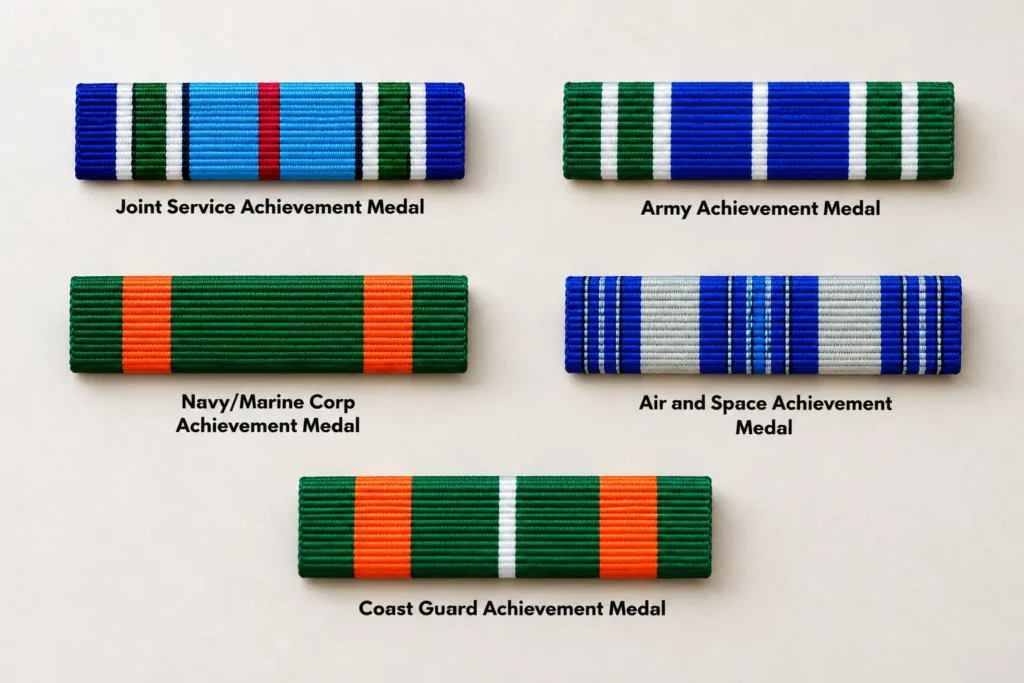
Search for “achievement medal” and you will get five different awards, because that is how many exist.
Most people only ever hold one, so the confusion usually starts somewhere specific: a joint assignment, a rack being built for a spouse, or a family working out what a father earned before anyone wrote it down. Then the real question appears. Which one is this, and what goes on it for the second award?
That last part is where racks go wrong, and the answer is not the same in every branch.
Quick Answer: Five versions of the achievement medal exist, one for each service plus a joint award. Each recognizes meritorious service or achievement of a lesser degree than that service’s Commendation Medal. Army, Air Force and Joint Service use oak leaf clusters for subsequent awards. Navy, Marine Corps and Coast Guard use 5/16 inch stars.
The Five Versions at a Glance
| Award | Established | Second award device | Worth knowing |
| Joint Service Achievement Medal | 1983 | Oak leaf cluster | A Department of Defense award. Ranks above every service achievement medal. |
| Army Achievement Medal | 10 April 1981 | Oak leaf cluster | Not awarded to general officers. |
| Navy and Marine Corps Achievement Medal | 1961, renamed twice since | 5/16 inch star | Ship and squadron commanding officers can award it without higher approval. |
| Air and Space Achievement Medal | 20 October 1980 | Oak leaf cluster | Renamed from Air Force Achievement Medal on 16 November 2020. |
| Coast Guard Achievement Medal | 1964 | 5/16 inch star | The only one that still takes a Combat “V”, plus the “O” device. |
The Achievement Medal Device That Gets Racks Built Wrong
This is the single most useful thing on this page, so here it is plainly.
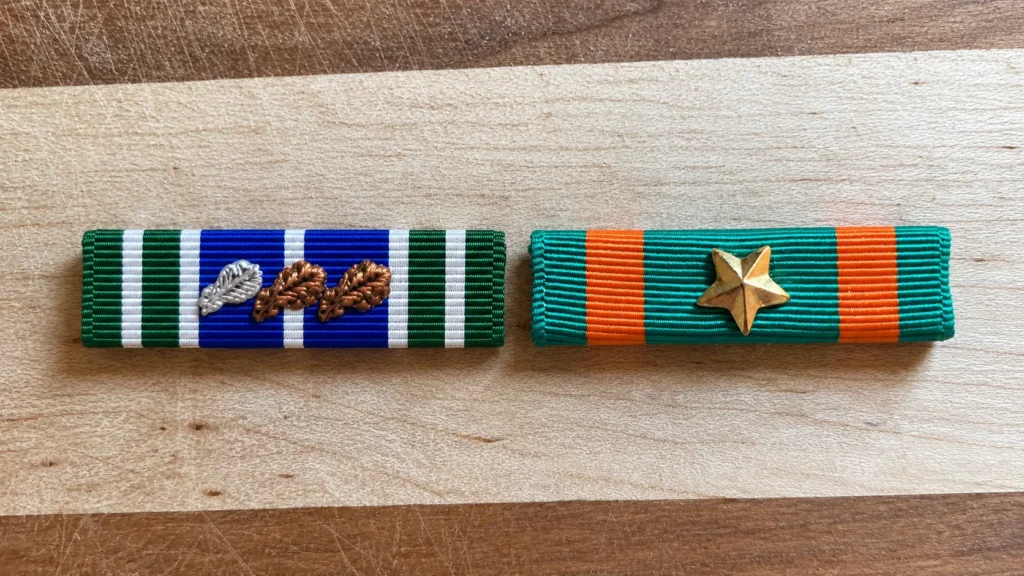
Army, Air Force, Space Force and Joint Service use oak leaf clusters. Bronze for each award after the first, with a silver cluster replacing five bronze ones.
Navy, Marine Corps and Coast Guard use 5/16 inch stars. Gold for each award after the first, with a silver star replacing five gold ones.
They are not interchangeable. An oak leaf cluster on the Navy and Marine Corps version is wrong, and so is a star on the Army one.
Most people never notice because they stay in one branch their whole career. The mistake shows up when someone holds awards from more than one service, which happens more often than you would think on joint staffs, and when a family member is ordering a set from an old DD Form 214 without knowing the convention.
The Valor Device, and the One Branch That Kept It
In December 2016 the Department of Defense restructured valor and combat devices across the services. That review retired the Combat “V” on the Army, Navy and Marine Corps, and Air Force versions, and two new devices took its place.
The “C” device marks achievement performed under combat conditions. The “R” device marks achievement with a direct and immediate effect on combat operations from a remote location. Both apply only to service on or after 7 January 2016, and neither is retroactive.
The Coast Guard is the exception. It still authorizes the Combat “V” alongside the “C” and “R” devices.
The Coast Guard also carries a device nobody else uses. The Operational Distinguishing Device, a silver 5/16 inch letter “O”, marks hands-on participation in an operational mission: search and rescue, firefighting, maritime law enforcement, disaster relief, pollution response, aids to navigation. Both the individual’s work and the unit’s mission have to be operational for it to apply.
Where the Achievement Medal Sits in Precedence
The pattern is consistent, which makes it easy to remember. Each one sits directly below its own service’s Commendation Medal.
Below it, the next award differs by branch. The Army places the Prisoner of War Medal next. Navy and Marine Corps racks continue with the Combat Action Ribbon, Air Force and Space Force racks with the Air and Space Combat Action Medal, and Coast Guard racks with the Commandant’s Letter of Commendation Ribbon.
The Joint Service version ranks above all of them, because Department of Defense awards outrank service awards of the same tier.
Our branch guides lay out the full sequence: Army, Navy, Air Force, Marine Corps, Coast Guard, and Space Force.
Branch by Branch
Army Achievement Medal. The Secretary of the Army established it on 10 April 1981. It recognizes meritorious service or achievement of a lesser degree than the Army Commendation Medal requires. Battalion commanders approve it. General officers cannot receive it, which is unusual among American decorations. Ribbon and full-size medal.

Navy and Marine Corps Achievement Medal. The oldest of the five. It began in 1961 as the Secretary of the Navy Commendation for Achievement, became the Navy Achievement Medal in 1967, and took its current name in 1994. Since 2002 commanding officers of ships and aviation squadrons have been able to award it without sending it up the chain, which is why Sailors and Marines often hold several. Ribbon and full-size medal.

Air and Space Achievement Medal. Authorized on 20 October 1980 and renamed on 16 November 2020 so it would cover Guardians as well as Airmen. Same criteria, same ribbon, new name. Our full guide to the Air Force version covers the rename and the devices in detail. Ribbon and full-size medal.

Coast Guard Achievement Medal. Dates to the 1960s, and sources differ between 1963 and 1967. It carries the widest range of devices of any achievement medal, including the Combat “V” and the Operational Distinguishing Device. Ribbon and full-size medal.

Joint Service Achievement Medal. Created in 1983 for service with a joint activity rather than a single branch. It outranks every service version. Ribbon and full-size medal.

Which One Do I Have?
If you are holding a citation or a DD Form 214 and cannot tell, three things narrow it quickly.
Read the issuing authority. A joint command or a Department of Defense agency points to the Joint Service award. A single service points to that service’s version.
Look at the device already on it. An oak leaf cluster means Army, Air Force, Space Force or Joint Service. A star means Navy, Marine Corps or Coast Guard.
Check block 13 of the DD Form 214. Decorations, medals, badges and campaign ribbons are listed there by name, which usually settles it outright.
Still unsure? Send us a photograph and we will tell you. There is no charge and no obligation to buy.
Build It Right
Our ribbon rack builder arranges everything in the correct order of precedence for your branch and gives you the right device- the oak leaf cluster or the star- without you having to remember which. Count and sequence come out right before we mount anything.
You can also browse our full range of military medals.
Already own a rack from us? We update racks originally bought from Super Thin Ribbons, so adding a second achievement medal means one device, not a new rack. Call before you send it and we will quote it.
Use code STR2025 for 10% off your order.
Built in the USA
Super Thin Ribbons is a U.S.-based company, headquartered at 1602 Loop 11, Wichita Falls, Texas 76306. You can reach our team directly at 940-851-6220 or sa***@**************ns.com.
We charge nothing extra for expedited production. If you have a ceremony coming, call us and we will tell you honestly whether we can meet the date.
Frequently Asked Questions
Five. The Joint Service, Army, Navy and Marine Corps, Air and Space, and Coast Guard versions.
It depends on the branch. Army, Air Force, Space Force and Joint Service use a bronze oak leaf cluster. Navy, Marine Corps, and Coast Guard use a gold 5/16 inch star. A silver device replaces five of the bronze or gold ones.
Directly below that service’s Commendation Medal. The Joint Service Achievement Medal ranks above all of the service versions.
Only on the Coast Guard version. December 2016, the Combat ” V ” was retired on the Army, Navy and Marine Corps, and Air Force versions and replaced by the “C” and “R” devices for service on or after 7 January 2016.
The Operational Distinguishing Device, a silver 5/16 inch letter “O”. It marks hands-on participation in an operational mission such as search and rescue, maritime law enforcement, disaster relief or pollution response.
The lower award recognizes meritorious service of a lesser degree than the commendation medal requires. The commendation ranks above it in every branch.
Thank You
These awards rarely come with a story anyone tells at dinner. They come from an inspection that went well, a deployment that ran clean, a watch stood properly for months.
That is most of what a military actually runs on, and it deserves to sit on the rack in the right place with the right device.
Thank you for reading. If you are unsure which one you hold or what belongs beside it, call us at 940-851-6220. We would rather work it out with you than have you guess.