


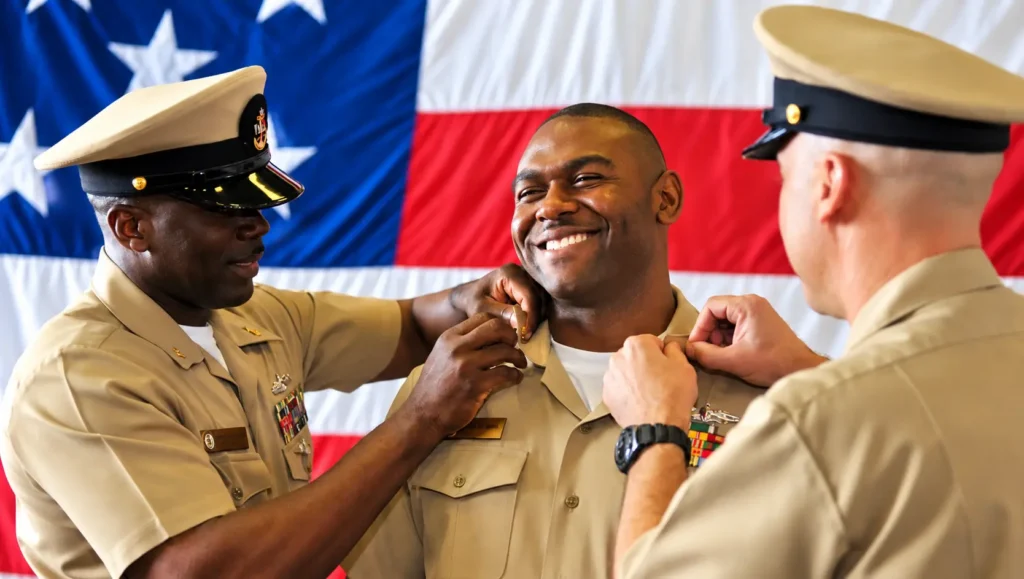
Somebody in your family is about to make Chief, and a question has started going around the group chat. What is the Chief pinning ceremony uniform, and what are the rest of us supposed to wear?
It is a fair question, and the answer is harder to find than it should be. Most people say “dress nicely” and leave it there. Meanwhile, the hosting command has usually published something far more specific, and guests rarely see it.
Quick Answer: Civilian guests wear business casual. Chiefs and officers attending wear Service Khakis with the combination cover. Sailors E-6 and below wear the uniform of the day. Selectees wear khakis and receive the gold fouled anchors and combination cover during the ceremony. Military guests stay seated and uncovered unless they take part.
What Actually Happens, in Order
Knowing the sequence makes the clothing question answer itself, because you can see where you fit.
A typical ceremony runs like this. The selectees march in. The color guard parades the colors, the national anthem plays, and a chaplain gives the invocation. A guest speaker, usually a senior enlisted leader, addresses the room.
Then come three readings that carry the whole ceremony: the Fouled Anchor, the Frocking Letter, and the Donning of the Cover. These are not filler. They explain the anchor, grant the authority, and introduce the cover, in that order. Navy Medicine’s coverage of a recent pinning gives a good sense of how the morning feels from the floor.
Next comes the part everyone came for. The Mess calls selectees forward in groups. Someone close to them pins the gold fouled anchors on the collar, the combination cover goes on, and a bell rings as each new Chief steps through. After the last one, the Mess recites the Chief Petty Officer’s Creed. Closing remarks, a benediction, a song from the Mess, and a group photograph.
The whole thing usually runs a little over an hour.
The Chief Pinning Ceremony Uniform for the Selectee
Khakis, the combination cover, and the gold fouled anchor collar devices. They walk out in that uniform, though most ceremonies add the anchors and the cover during the pinning rather than before it.
The fouled anchor is a gold anchor with USN in silver. It is a small object that costs a surprising amount of money by the time you have assembled everything around it.
That last point deserves emphasis, because it catches people out every year. Moving from E-6 to Chief means buying a largely new uniform, and the total runs higher than most selectees expect. Price the whole change early in the season rather than in the final week, when you are competing with everyone else at the command for the same items.
Chief Pinning Ceremony Uniform Guidance for Everyone Else
Commands publish this, and the chief pinning ceremony uniform guidance stays consistent across the fleet. Here is how it breaks down.
| Who you are | What to wear |
| Civilian guest, family member | Business casual |
| Chief Petty Officer attending | Service Khakis with combination cover |
| Commissioned officer attending | Service Khakis with combination cover |
| Sailor E-6 and below | Uniform of the day |
| Selectee | Khakis, anchors and cover added during the ceremony |
Business casual is the answer for families, and it is worth saying plainly because the uncertainty causes real stress. For men that means slacks and a collared shirt, with a jacket if you like. For women, a dress, skirt or slacks with a blouse. Nobody expects black tie. Nobody expects you to turn up in something with an anchor printed on it either.
Two practical notes from people who have sat through these. Commands often hold ceremonies in hangars, on piers or in gyms, so expect a concrete floor and a room that runs cold or very warm. You will also stand for photographs afterward. Choose shoes accordingly.
One thing to confirm before the day. The hosting command sets the chief pinning ceremony uniform, and it can differ from the table above depending on season, location and local policy. The Chiefs’ Mess running the ceremony will tell you if you ask, and they would far rather answer the question than have a family worrying about it.
Who Pins the Anchors
This is the question families care most about, and the answer is the reason the ceremony is moving.
Someone meaningful to the new Chief does the pinning. Usually a spouse, a parent or a child, and sometimes a mentor, often a retired Chief who set them on the path twenty years earlier. That same person, or another family member, then places the combination cover.
Being asked to do it means something. Practice once beforehand if you can, because collar devices are fiddly and hands shake more than people expect. Ask a Chief at the rehearsal to show you how.
The Etiquette Nobody Explains to Guests
Three things that are not obvious if you have never attended one.
Hold your applause. Commands typically ask guests to wait until the last selectee leaves the stage, then applaud together. Clapping for the first name and not the fifteenth is the thing to avoid.
Military guests stay seated and uncovered. Unless you take part in the ceremony or someone prompts you, stay seated during the piping and keep your cover off indoors.
You can come forward for photos. Most ceremonies explicitly invite guests to step up and photograph the pinning. This surprises people who assume they should stay in their seat. If the program says you may, go. These photographs end up framed.
The Six Week Window
The time between selection results and pinning day runs roughly six weeks, and the ceremony is traditionally held in mid-September, although each command sets its own date inside Navy guidance. Advancement and selection information is published through MyNavy HR.
Worth knowing: the pinning date and the official advancement date do not always match. The Navy publishes effective dates separately by increment, so the paperwork may say one date while the ceremony happened on another.
Six weeks sounds like plenty. It is not, once you account for everything competing for it. If you are a selectee reading this in the first week, order the uniform items now.
Get the Rack Right Before the Photographs
Here is the part that gets left to the last minute every single year.
Your awards do not change when you make Chief, but the uniform carrying them does, and pinning day ranks among the most photographed moments of a Navy career. Your family frames the rack in those photographs.
It is also the moment plenty of people realize their rack has not caught up since two commands ago.
Our ribbon rack builder arranges everything in correct order of precedence for the Navy and handles the devices. Count and sequence come out right before we mount anything. You can browse all Navy ribbons and military medals. Our Navy ribbon order of precedence guide lists every award in sequence, and our guide to building a Navy ribbon rack walks through the mounting.
Ball season follows close behind pinning season, so it is worth reading our guide to what medals to wear to mess dress while you are here.
Already own a rack from us? We update racks originally bought from Super Thin Ribbons, so adding a recent award does not mean replacing the whole thing. Call before you send it and we will quote it.
Use code STR2025 for 10% off your order.
Built in the USA
Super Thin Ribbons is a U.S.-based company, headquartered at 1602 Loop 11, Wichita Falls, Texas 76306. You can reach our team directly at 940-851-6220 or sa***@**************ns.com.
We charge nothing extra for expedited production. If your pinning date is close, call us and we will tell you honestly whether we can meet it.
Frequently Asked Questions
Business casual. Slacks and a collared shirt, or a dress, skirt or blouse. Commands publish this guidance for guests, and it is the standard answer across the fleet. Confirm with the hosting Chiefs’ Mess if you want to be certain.
Service Khakis with the combination cover. Sailors E-6 and below wear the uniform of the day, which the hosting command sets.
Khakis. The gold fouled anchor collar devices and the combination cover go on during the ceremony itself. The anchor is a gold fouled anchor carrying USN in silver.
Someone meaningful to them, most often a spouse, parent, child or mentor. The same person or another family member usually places the combination cover.
Traditionally, mid-September, roughly six weeks after selection board results. Each command sets its own date within Navy guidance, and the official advancement date can differ from the ceremony.
No. Commands normally ask guests to hold applause until the end, then applaud together. Most ceremonies do welcome guests to come forward and take photographs during the pinning.
Thank You
The Navy established the Chief Petty Officer grade on 1 April 1893, a date recorded by the Naval History and Heritage Command, which makes 2026 the 133rd pinning season. Everyone who dons anchors this fall joins a line running back that far.
If the anchors are yours, congratulations. You already know what it took. And if you are the family member reading this at eleven at night trying to work out what to wear, you are exactly the sort of person who makes a career like that possible.
Thank you for reading. If your rack needs to be right before the photographs, call us at 940-851-6220, and we will help you sort it.