



For twenty years, the Global War on Terrorism Service Medal stood among the most widely held awards in the United States military. Millions of service members earned it. Then, in September 2022, the rules changed, and many people still rely on the old criteria.
This guide explains what the medal is, who qualifies for it today, what the ribbon looks like, and where it belongs on your rack. We have kept the information direct and practical because service members frequently ask about this award.
Quick Answer: The Global War on Terrorism Service Medal recognizes service members who take part in designated counter-terrorism operations. President Bush established it through Executive Order 13289 on March 12, 2003, with eligibility reaching back to September 11, 2001. Since September 11, 2022, service members need 30 days of direct service in a designated counter-terrorism operation to qualify. Physical combat with a foreign terrorist also qualifies regardless of duration. Each individual can receive only one award, so the military does not authorize service stars for this medal.
What Is the Global War on Terrorism Service Medal?
President George W. Bush created the Global War on Terrorism Service Medal by Executive Order 13289, signed on March 12, 2003. The same order created its companion award, the Global War on Terrorism Expeditionary Medal.
Eligibility dates back to September 11, 2001, so service members can receive credit for qualifying service that occurred during the 18 months before the medal was established.
The Service Medal recognizes participation in the counter-terrorism effort. The Expeditionary Medal recognizes deployment into the theaters where that effort took place. That distinction between supporting the campaign and deploying for it helps explain the different eligibility rules.
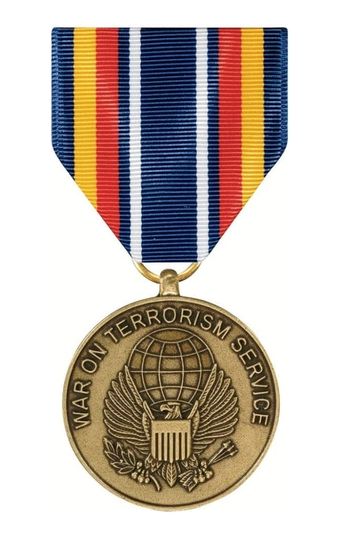
The medal itself measures one and a quarter inches across and features a bronze design. The front shows an eagle with spread wings and a shield of thirteen vertical bars on its breast. The eagle holds an olive branch in one claw and three arrows in the other, with a terrestrial globe above. The inscription reads WAR ON TERRORISM SERVICE MEDAL. The reverse shows a laurel wreath on a plain field.
Who Qualifies for the Global War on Terrorism Service Medal?
This question matters most, and today’s answer differs from the criteria many service members remember.
The Rules Since September 11, 2022
A service member qualifies through either of these routes:
Direct service in a designated counter-terrorism operation for 30 days, consecutive or non-consecutive, while on active duty.
Physical combat with a foreign terrorist, or with an individual inspired or motivated by a foreign terrorist organization. Combat qualifies regardless of duration.
What Changed in 2022?
Before September 11, 2022, the military used a much broader standard. Thirty consecutive days or 60 non-consecutive days in support of a Global War on Terror mission could qualify, and that support could include direct or indirect participation.
In practice, that broader standard allowed many service members who served during the period to receive the medal. That explains why the award appears on so many military racks.
The Department of Defense removed indirect support from the eligibility criteria. Current guidance makes clear that indirect support, under the previous definition, no longer qualifies someone for the medal.
Army Major Charlie Dietz explained the reasoning at the time. He pointed to the withdrawal of combat troops from Afghanistan and the shift of the Iraq mission toward an advise, assist, and train role.
If You Already Have the Medal
The 2022 change does not revoke medals that service members earned under the older criteria. If you earned the medal before the rules changed, you keep it and continue to wear it.
If you are unsure whether service after September 2022 qualifies, contact your personnel office or command career counselor. They can compare your service with the current eligibility guidance.
Is the Global War on Terrorism Service Medal Still Awarded?
Yes. No announced end date exists.
The military continues to issue the award under the narrower 2022 criteria. Its continuation ties to the national emergency declared in Presidential Proclamation 7463. The government has extended that declaration repeatedly, most recently through at least September 14, 2026.
So, is the military still awarding the Global War on Terrorism Service Medal? Yes. However, far fewer service members qualify today than they did before 2022.
Service Medal or Expeditionary Medal? The Difference That Trips People Up
These two awards came from the same executive order on the same day, so service members often confuse them. The key difference becomes clear when you compare them directly.
| Difference | GWOT Service Medal | GWOT Expeditionary Medal |
| Recognizes | Participation in designated counter-terrorism operations | Deployment into a designated area of eligibility |
| Where you served | Includes service outside deployed theaters | Requires qualifying deployment to a designated nation or body of water |
| Time standard | 30 days of direct service, or combat regardless of time | 30 consecutive or 60 non-consecutive days, or combat |
| Service stars | None. Only one award is authorized | Bronze service stars can mark additional operations |
| Precedence | Lower | Higher |
Both medals came from Executive Order 13289, which President Bush signed on March 12, 2003.
The Expeditionary Medal covers deployment to Afghanistan, Iraq, and more than 50 other countries across Africa, Asia, Europe, and the Middle East. Designated waters also count, including the Persian Gulf, Red Sea, and parts of the Mediterranean and Arabian seas.
One important change came on April 30, 2005. The Afghanistan Campaign Medal and Iraq Campaign Medal replaced the Expeditionary Medal for qualifying service inside those two countries. Members who had already earned the Expeditionary Medal for that service could exchange it for the campaign medal or keep the original.
Later, the military created the Inherent Resolve Campaign Medal for operations against ISIS, with eligibility reaching back to June 15, 2014.
Did you serve in Iraq or Afghanistan during the early years of the campaign? Check your record carefully. Your exact dates determine which medal belongs on your rack.
Does the GWOT Service Medal Take a Bronze Star?
No. This question comes up often, so the answer deserves a direct explanation.
Each individual can receive the Global War on Terrorism Service Medal only once. Because the military does not award a second Service Medal, current regulations do not authorize bronze or silver 3/16-inch service stars for it.
The military eliminated campaign and battle star authority for this medal in January 2016. Officials had not authorized those devices before that change.
The confusion usually comes from the companion award. The Global War on Terrorism Expeditionary Medal does take bronze service stars. Officials authorized those stars beginning February 9, 2015, with each star representing an additional designated operation.
So, if you see a listing for a Global War on Terrorism Service Medal with a bronze star, the star does not belong on that medal. If your official record shows a device on this medal and you do not know why, contact your personnel office before mounting it.
What Does the GWOT Service Medal Ribbon Look Like?
The ribbon measures one and three-eighths inches wide and appears predominantly dark blue.
A dark blue stripe runs through the center, bordered by white pinstripes. Dark blue pinstripes then frame those white stripes. Larger stripes of scarlet, gold, and dark blue complete the design, with dark blue forming the outer edges.

The colors carry straightforward symbolism. Scarlet, white, and blue represent the United States, while gold represents excellence.
On a ribbon rack, the award looks like a blue ribbon with fine red and gold banding toward each edge. Its appearance can make it easy to confuse with the Expeditionary ribbon at a glance.

Where Does It Sit in the Order of Precedence?
The Global War on Terrorism Service Medal belongs in the service and campaign medal group, below personal decorations and unit awards.
| Position | Award |
| Immediately before | Global War on Terrorism Expeditionary Medal |
| The award | Global War on Terrorism Service Medal |
| Immediately after | Korea Defense Service Medal |
The Expeditionary Medal outranks the Service Medal. If you hold both, place the Expeditionary Medal higher on your rack.
Each military branch publishes its own complete order of precedence. For the full sequence, see our guides for the Army, Navy, Air Force, Marine Corps, Coast Guard, and Space Force.
Is It Different for the Army, Air Force, or Navy?
No. The Department of Defense established this award, so the eligibility criteria remain the same across the Army, Navy, Air Force, Marine Corps, Space Force, and Coast Guard.
The medal, ribbon, and eligibility standard do not change by branch.
What does change is the ribbon’s position on the rack. Each branch maintains its own order of precedence, and each service handles the administrative process through its own personnel system.
Each service also announced the 2022 eligibility change through its own guidance. The Navy, for example, issued a NAVADMIN, while the Coast Guard issued an ALCOAST. The underlying eligibility standard remains the same.
What Qualifies as a GWOT Veteran?
People use the phrase “GWOT veteran” in two different ways, so it helps to separate them.
For military awards, recognition comes through the Service Medal, Expeditionary Medal, or a campaign medal for Afghanistan, Iraq, or Inherent Resolve.
For benefits and eligibility, the term has a broader meaning. Veterans organizations, employers, and state programs can use different definitions. Many use active-duty service beginning September 11, 2001, as part of their criteria.
Post-9/11 GI Bill eligibility, VA health care priority groups, and veterans organization membership rules each have their own requirements.
We build ribbons, not benefits determinations. For questions about benefits or entitlements, contact the Department of Veterans Affairs at va.gov or speak with a veterans service officer. They can review your individual record and provide the appropriate answer.
How to Check Your Own Record
Step one: If you have separated from service, find your DD Form 214. Block 13 lists your decorations, medals, badges, and campaign ribbons.
Step two: If you still serve, contact your personnel office or command career counselor and ask them to pull your award history.
Step three: Compare your service dates with the applicable medals. Service in Iraq or Afghanistan before April 30, 2005, may fall under the Expeditionary Medal, while later qualifying service may fall under a campaign medal.
Step four: If something looks wrong, request a record review. Early campaign records sometimes contain gaps, and the appropriate authorities can correct qualifying records.
Step five: After your personnel office confirms your awards, build your rack correctly. Getting the device count right matters just as much as choosing the correct ribbons. For the Global War on Terrorism Service Medal, that means no service stars.
Build Your Rack the Easy Way
Once you know which awards you hold, building your ribbon rack should be the simple part.
Our ribbon rack builder arranges your awards according to the correct order of precedence for your branch and handles authorized devices. Select your ribbons, add the appropriate stars or clusters where applicable, and the tool organizes the rows.
You can also browse ribbons by branch:
- Army Ribbons
- Navy Ribbons
- Air Force Ribbons
- Marine Corps Ribbons
- Coast Guard Ribbons
- Space Force Ribbons
You can also browse our complete selection of military medals.
For more information, read our guides to the National Defense Service Medal and the Armed Forces Service Medal. Both awards sit near the GWOT Service Medal in military award discussions and often create similar questions about eligibility and precedence.
Use code STR2025 for 10% off your order.
Built in the USA
We make every ribbon and rack right here in the United States. Our ultra-thin profile sits flat against the coat and maintains a clean line across four rows.
Super Thin Ribbons is a U.S.-based company headquartered at 1602 Loop 11, Wichita Falls, Texas 76306. You can reach our team at 940-851-6220 or sa***@**************ns.com.
If you are unsure whether you hold the Service Medal or Expeditionary Medal, contact us before you order. Five minutes on the phone can prevent an incorrect rack.
Frequently Asked Questions
Since September 11, 2022, service members can qualify through two routes. The first requires 30 days of direct service, consecutive or non-consecutive, in a designated counter-terrorism operation while on active duty. The second involves physical combat with a foreign terrorist, regardless of duration. Indirect support no longer qualifies.
Service members qualify when they deploy to a designated area of eligibility for 30 consecutive or 60 non-consecutive days. Combat, death, or wounds in the line of duty can qualify regardless of time. The medal covers Afghanistan, Iraq, and more than 50 other countries, along with designated waters.
For awards, veterans receive recognition through the Service Medal, Expeditionary Medal, or a campaign medal for Afghanistan, Iraq, or Inherent Resolve. For benefits, each program can use different criteria. Check with the VA for questions involving benefits or entitlements.
Yes. No announced end date exists. The military continues to issue the medal under the narrower 2022 criteria, tied to the national emergency in Presidential Proclamation 7463, which has an extension through at least September 14, 2026.
Service members need 30 days of direct participation in a designated counter-terrorism operation while on active duty. Physical combat with a foreign terrorist also qualifies, with no minimum duration.
Eligibility begins September 11, 2001. President Bush established the medal on March 12, 2003, through Executive Order 13289. The military narrowed the eligibility criteria on September 11, 2022. No end date has been announced.
Yes. Service members can receive both for different qualifying service. The military generally does not award both medals for the same period, although a narrow exception applies to some Iraq and Afghanistan service before April 2005.
No. Each individual can receive only one Global War on Terrorism Service Medal, so the military does not authorize service stars for it. The Expeditionary Medal can take bronze service stars, which causes much of the confusion.
Thank you for your service. Some carry this medal from a deployment. Others carry it from years of quiet work that made those deployments possible. Either way it marks a chapter of American history that a great many people gave a great deal to, and we are proud to help you wear it correctly.