



The National Defense Service Medal (NDSM) is a U.S. military service award established by President Eisenhower in 1953 to honor all honorable service during designated national emergencies. It has been issued for four major conflict periods – Korea, Vietnam, the 1990–91 Gulf War, and the post-9/11 war on terror – to millions of service members.
Quick Answer: The National Defense Service Medal recognizes honorable active service during four designated periods of national emergency. Award eligibility ended on 31 December 2022. A bronze service star marks each additional qualifying period.
What Is the National Defense Service Medal?
The NDSM was created near the end of the Korean War as a “blanket” service medal for anyone on active duty during a national emergency. President Eisenhower issued Executive Order 10448 on 22 April 1953, establishing the medal “for award…to members of the armed forces…who shall have served during any period between June 27, 1950, and a terminal date to be fixed by the Secretary of Defense”. In practice, the Secretary of Defense later set the exact eligibility dates for each conflict. Over the next seven decades, the NDSM was reissued during four wars or emergencies: the Korean War, Vietnam War, Desert Storm (Gulf War I), and the Global War on Terrorism.
The NDSM’s history is woven into the fabric of Cold War and post-9/11 America. After its first issuance ended in 1954, it was revived from 1961–1974 for Vietnam, again in 1990–1995 for the Gulf War, and from 11 Sep 2001 through 31 Dec 2022 for the Iraq/Afghanistan era. During each period, the Secretary of Defense announced when the medal would be active and when it would expire. The medal’s nickname, the “pizza stain,” comes from its bold yellow-and-red ribbon pattern, which generations of service members have seen atop their uniform. In late 2022, Secretary Austin announced that the NDSM would be retired again; after 31 Dec 2022, new enlistees no longer receive the medal.
Which Periods Qualify for the National Defense Service Medal?
The NDSM is awarded to anyone who serves honorably on active duty (or meets equivalent reserve status) during the specified dates of an eligible conflict. The four qualifying periods are as follows:
| War | Start Date | End Date | Notes |
| Korean War | 27 Jun 1950 | 27 Jul 1954 | Honorable active service in any location. |
| Vietnam War | 1 Jan 1961 | 14 Aug 1974 | Includes the entire Vietnam conflict period. |
| Desert Shield/Desert Storm (Gulf War) | 2 Aug 1990 | 30 Nov 1995 | Covers Operations Desert Shield/Storm. |
| Global War on Terrorism | 11 Sep 2001 | 31 Dec 2022 | Post-9/11 operations; ceased issuance after 2022. |
Each of these date ranges was officially announced by the Secretary of Defense or through an Executive Order. In general, all U.S. Armed Forces personnel (Army, Navy, Air Force, Marine Corps, and Coast Guard) on active duty or serving honorably in the Selected Reserve during these dates are eligible. (For example, in 2003, an Executive Order extended the medal to Army National Guard and Reserve members in good standing.) However, short inactive training periods or temporary duty for boards/physical exams do not qualify as active duty service. Officer cadets who are sworn into service are eligible to receive the medal. The award may be granted posthumously.
How Awards are Noted: If a service member qualifies during more than one of these periods (e.g., served in Vietnam and Iraq), the medal itself is only worn once, but a bronze service star is attached to the ribbon to indicate a second (or third) award. (Silver stars are used on ribbons to denote five awards, though no one yet has that many NDSM awards.)
What Does the National Defense Service Medal Ribbon Look Like?
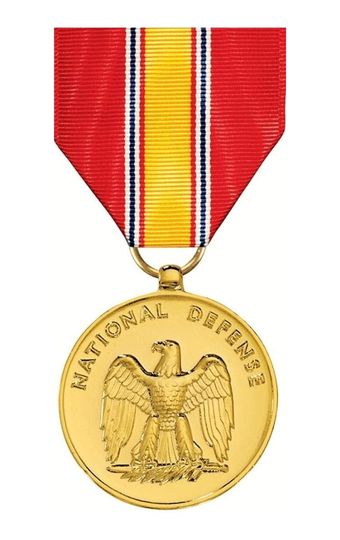
The medal itself is a bronze disk 1¼ inches in diameter. On the front (obverse) is a spread-winged bald eagle perched on a sword and palm frond. Above the eagle is the raised inscription “NATIONAL DEFENSE” in a semicircle. The reverse side shows a U.S. shield (from the Great Seal) surrounded by an oak branch on the right and a laurel sprig on the left, tied at the base. These classical symbols of strength and victory reflect the medal’s purpose as a national service award.
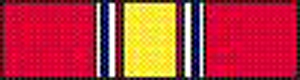
The ribbon is 1 3/8 inches wide and has a distinctive color pattern. As one description notes: “The ribbon has a wide yellow stripe in the center, flanked by four narrow stripes of red, white, blue, and white, and wide red stripes.” In precise terms (from edge to center and back to edge), the stripe pattern is: red–white–blue–white–red–golden yellow–red–white–blue–white–red. The yellow center stripe is about ¼ inch wide, the broad outer red stripes are 7/16 inch each, and the five intervening narrow stripes are 1/32 inch each (red, white, blue, white, red). (See table below.) These bright primary colors give the ribbon its “pizza stain” look and patriotic flair.
| Stripe Color | Width (inches) |
| Scarlet Red (edge) | 7/16 (0.4375) |
| White | 1/32 (0.03125) |
| Old Glory Blue | 1/32 (0.03125) |
| White | 1/32 (0.03125) |
| Scarlet Red | 1/32 (0.03125) |
| Golden Yellow (center) | 1/4 (0.25) |
| Scarlet Red | 1/32 (0.03125) |
| White | 1/32 (0.03125) |
| Old Glory Blue | 1/32 (0.03125) |
| White | 1/32 (0.03125) |
| Scarlet Red (edge) | 7/16 (0.4375) |
Where Does the NDSM Sit in the Order of Precedence?
The NDSM is a service ribbon, worn on the left chest among a service member’s other ribbons. Its official precedence is relatively low, as it is not a combat or campaign medal. In practice, the NDSM ribbon is worn after all campaign and service medals of higher precedence (e.g., after any Vietnam Service or Iraq Campaign ribbons) and before lower awards. It follows general order of precedence rules as set by each service’s uniform regulations (see AR 670-1, AFI 36-2903, etc.).
For multiple awards, wear a bronze 3/16″ service star on the ribbon for a second award (and a silver star instead of five bronze). (Each bronze star represents one additional conflict period of qualifying service.) As with other U.S. ribbons, the NDSM ribbon is attached to a metal bar and aligned with other ribbons in rows. The flat service ribbon bar is 1⅜″ wide by ¾″ tall.
Veterans often note that the bold colors of the NDSM make it one of the most recognizable ribbons. Its “pizza stain” pattern (yellow and red) was a common fixture on uniforms for decades. Yet, because it is so commonly earned, it was sometimes overlooked in paperwork. In any case, it must be worn with all other awards according to the normal rules (one medal ribbon per rack slot, stars centered, etc.). For detailed guidance, see the current uniform regulation (e.g., Army AR 670-1 or Air Force AFI 36-2903) on service ribbon order and devices.
Ready to display your service proudly? Use our Rack Builder Tool to arrange your ribbons correctly on a rack.
Is the National Defense Service Medal Still Awarded?
No. A Department of Defense memorandum dated 30 August 2022 set the award termination date, and eligibility closed on 31 December 2022. Service after that date does not qualify.
The four qualifying periods are these:
| Period | Inclusive dates |
| Korean War | 27 June 1950 to 27 July 1954 |
| Vietnam War | 1 January 1961 to 14 August 1974 |
| Gulf War | 2 August 1990 to 30 November 1995 |
| Global War on Terrorism | 11 September 2001 to 31 December 2022 |
Only one award is authorized for each period. Therefore, a service member who served during two separate periods wears the ribbon with one bronze service star, and someone who served across three periods wears two.
Frequently Asked Questions
A: Any U.S. armed forces member on active duty (or in qualifying reserve status) during one of the four authorized periods listed in the table above. There are no rank or combat requirements – merely honorably serving during those dates earns the award. Officer cadets who are sworn in (at academies or OCS) also qualify.
A: After over 21 years of continuous issuance for the Global War on Terrorism, the Department of Defense decided that large-scale combat operations had ended. Secretary Austin issued a memo (effective 1 Jan 2023) stating the NDSM is no longer awarded to new enlistees. This reflects a shift to a peacetime posture. (Service members on active duty before that date remain eligible.)
A: It is a striped ribbon with a wide golden-yellow center stripe, flanked by narrow red-white-blue-white stripes, and wide scarlet (red) edges. Official specs (from AR 600-8-22) list the exact stripe widths as given above. Its bright red–yellow pattern earned it the nickname “pizza stain.”
A: Even if you earned it in multiple periods, you still wear only one NDSM ribbon. Additional awards are shown by bronze service stars on the ribbon. For example, a veteran who served in Vietnam and the Gulf War would wear one NDSM ribbon with a bronze star.
A: No – that’s a common myth. The NDSM is a service medal, not a combat or campaign medal. It simply signifies that you served honorably during a national emergency period. It does not indicate participation in combat or a specific battle.
A: Actually, any length of active duty during an eligible period qualifies, even less than 90 days. Some confusion arises because other awards (like campaign medals) do have minimum time. But the NDSM has no minimum time-on-duty requirement for the initial award.
A: Yes. Even though it’s not issued to new enlistees after 2022, the NDSM remains a valid award. Anyone who earned it before 2023 continues to wear it on their uniform. It appears in current uniform regs (AR 670-1/AFI 36-2903, etc.) in the service ribbon order of precedence.
Build your rack
At Super Thin Ribbons, every rack is built to military specifications with accurate precedence, correct ribbon dimensions, and a low-profile design trusted by active-duty personnel, veterans, retirees, and first responders. Whether you’re preparing for a ceremony, promotion, inspection, or retirement, we’ll help you look sharp.
Build Your Ribbon Rack now with our easiest rack builder!!!
To every service member, veteran, and retiree, thank you for your service. Your ribbons and Medals tell a story worth wearing proudly.