


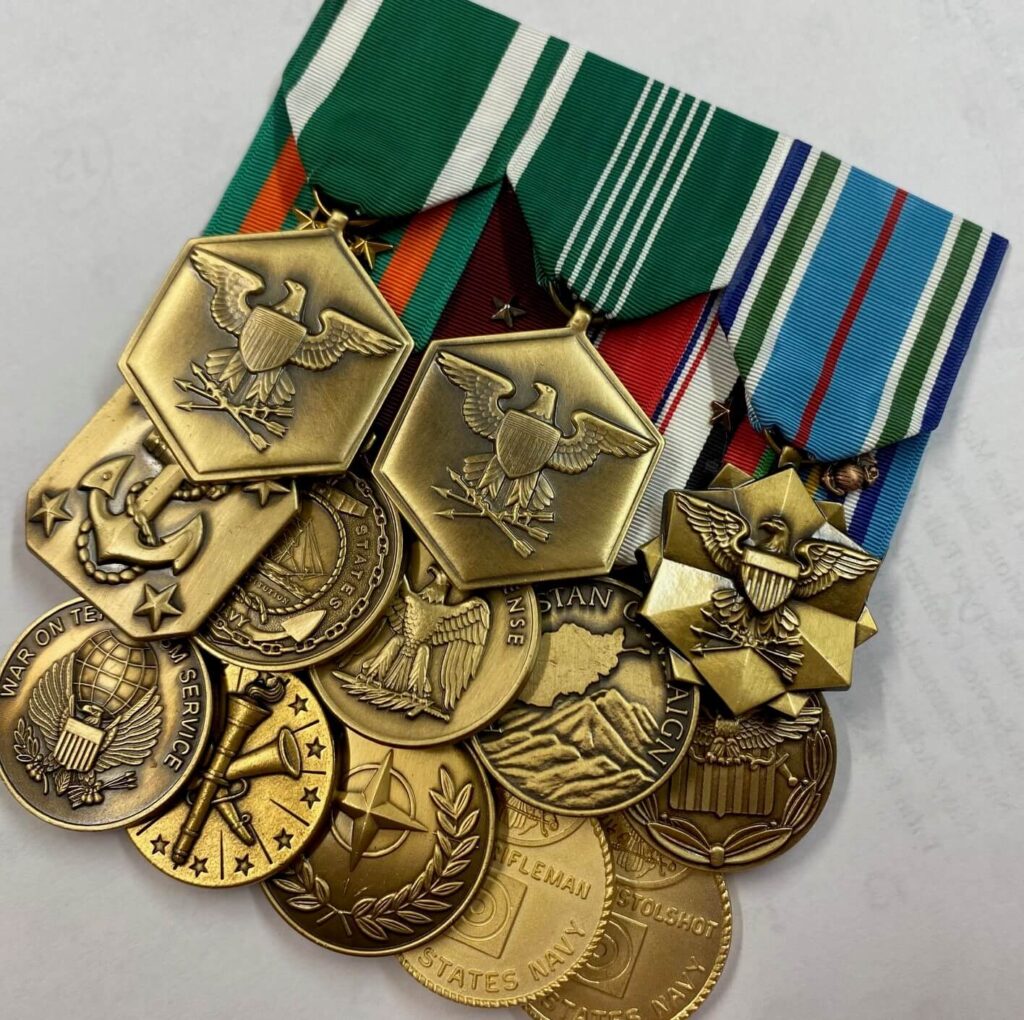
Military medals are powerful symbols of service, sacrifice, and achievement. Full-size medals – the larger, official versions – are normally reserved for formal ceremonies, parades, and official military functions, while miniature medals (about half the size) are commonly worn with evening dress and at social occasions. Both represent the same awards and honors. The choice of full or mini depends on uniform type, branch regulations, and occasion.
For example, U.S. Army regulations specify that only miniature medals are authorized on mess or evening uniforms, whereas service and dress uniforms use full-size medals. Similarly, the U.S. Air Force mandates miniature medals on mess dress, though veterans may wear either size on civilian suits. In the U.S. Navy and Marine Corps, formal or “white tie” events call for miniature medals, while full dress uniforms (e.g. Full Dress Blue) use full-size medals.
British tradition likewise prescribes miniatures with evening dress (dinner jackets) and full-size decorations on day uniforms. This article covers when to wear each style, branch-specific rules, international variations (including UK practice), the history of miniatures, pros and cons, care tips, and buying guidance for quality miniature medals and thin ribbon racks.
Comparing Miniature vs Full-Size Medals
Miniature and full-size medals have the same designs and meanings – they just differ in size and use. A typical full-size medal is about 1.3 inches wide (suspension ribbon plus medallion) and is quite heavy when wearing multiple awards. A miniature medal is roughly half-scale (around 0.5–0.625 inches wide) and much lighter. Below is a quick side-by-side comparison:
| Attribute | Miniature Medals | Full-Size Medals |
| Dimensions | ~½ size of full medal (approx. 0.5–0.625″ wide) | Full medal plus ribbon (typically ~1.3″ wide) |
| Weight | Much lighter; easier to wear in quantity | Heavier; can become bulky with many medals |
| Typical Occasions | Evening/formal events (dinner dress, mess dress); civilian black-tie suits | Daytime formal ceremonies, parades, honor guards, and official functions |
| Uniform Type | Mess dress, evening dress, formal civilian (lapel-worn) | Service/dress uniforms, full dress blues, parades |
| Pros | Comfortable for long wear; neat, elegant look; lightweight | Highly visible at a distance; traditional for ceremonies; makes an impressive display |
| Cons | Less visible from afar; not worn on most duty uniforms | Heavy, can be burdensome when many awards are worn |
| Attachment Style | Mounted on a small bar (often on a lapel or dinner jacket), no ribbons are worn with them | Mounted on larger medal holding bar on left breast; suspension ribbons visible |
This table highlights key differences. Both versions carry identical honors – the choice is about the right look for the event and uniform regulations. As one source notes, there is no difference in prestige between a mini and a full medal – only in size and when they may be worn.
When to Wear Full-Size Medals
Full-size medals are traditionally worn on dress and service uniforms for formal daytime ceremonies and official events. Common occasions include:
- Parades and Ceremonies: Veterans’ parades, Memorial Day ceremonies, change-of-command parades, and inspection ceremonies. Full-size medals ensure decorations are visible at a distance.
- Official Military Functions: Formal military banquets, award ceremonies, retirements, and promotional events typically require full medals on the prescribed dress uniform.
- Uniform-Required Events: Any event specifying formal military attire often means service (Class A/B) or dress uniforms with full medals. For example, the U.S. Army explicitly allows full-size medals on the service/dress uniform.
- Mourning and Memorial Services: On memorial uniforms or when wearing uniform to civilian funerals or wreath-laying ceremonies, service members usually wear full medals (unless regulations allow miniatures on civilian dress).
The U.S. Navy specifies that “large medals are worn on the wearer’s left side of the service coat and jumper of Full Dress uniforms”. In the Marine Corps, the Evening Dress “B” uniform (the male blue jacket) is the equivalent of the Navy’s Full Dress Blue and uses full-size medals in line with those rules. In most cases, any uniform designated as “Full Dress” will use full-size awards.
When to Wear Miniature Medals
Miniature medals are primarily for evening and formal social occasions. Key situations include:
- Military Balls and Mess Dress Events: Any formal military dinner or ball usually calls for miniature medals. Branch regulations (e.g. Army, Air Force) explicitly permit only miniatures on mess dress.
- Black Tie or White Tie Civilian Events: On civilian evening dress (tuxedo or tailcoat), miniatures may be worn on the left lapel. For example, U.S. regulations allow the Medal of Honor and miniature medals on civilian evening wear.
- Formal Dinners and Banquets: Veterans and military often wear miniatures at association dinners or diplomatic receptions. Mini medals provide a polished look without overshadowing civilian attire.
- Social Functions: In many military cultures, miniatures are preferred for cocktail parties, wedding receptions (military presence), or charity events where business attire or civilian suits are worn with decorations.
For example, the Marine Corps orders that “miniature medals will be worn on all evening dress uniforms. When miniature medals are worn, no ribbons will be worn”. Similarly, the U.S. Air Force mandates miniature medals on its mess dress uniform. Navy regulations echo this: “Wear miniature medals with all formal dress uniforms and dinner dress uniforms”, meaning every dress jacket from full dress white to enlisted dinner dress uses miniatures.
Tip: If you’re unsure, consider the occasion’s time and dress code. As a rule of thumb, if it’s evening or indoors, miniatures are usually correct; if it’s a daylight ceremony or parade, go with full-size medals.
U.S. Branch-Specific Guidelines
Each U.S. service branch publishes uniform regulations. In practice, they agree on the mini/full convention but use different terms:
- U.S. Army: AR 670-1 states that only miniature decorations are authorized on mess and evening mess uniforms, and no full-size medals or ribbons are worn with them. Soldiers and Army veterans wear full-size medals on standard service (Class A) uniforms and formal dress (Class A with ribbon bar or medals).
- U.S. Navy: Navy Uniform Regulations (Chapter 5) specify full-size medals for Full Dress uniforms (Full Dress Blue/White) and miniature medals for Formal and Dinner Dress uniforms. Additionally, on officer dinner jackets and enlisted dinner dress, miniatures are centered on the lapel. No ribbons are worn on Navy dinner or formal uniforms.
- U.S. Marine Corps: Marine Corps Order MCO P1020.34H directs that miniature medals and the Medal of Honor go on all evening dress uniforms. Marines wear full-size medals on Blue Dress A/B and Service A uniforms (the standard formal uniforms of day), and miniatures on Blue/White Evening Dress (their equivalent of mess dress).
- U.S. Air Force & Space Force: AFI 36-2903 requires miniature medals on both men’s and women’s formal/mess dress. Air Force personnel wear full-size medals on Service Dress and Dress Blue uniforms. Retirees or reservists in civilian settings may wear either size on suits: AFI explicitly allows “full-size or miniature medals on civilian suits or equivalent dresses”. (The Space Force follows Air Force rules by default.)
- U.S. Coast Guard: Coast Guard uniform rules (COMDTINST M1020.6) align closely with Navy practice. Coastguardsmen use full-size medals for Dress Blue uniforms and miniatures for formal dinner dress and night uniforms. Licensed CG sources similarly note miniature medals are standard on dinner dress jackets.
- Veteran & Civilian Wear: Across branches, veterans and retired personnel may wear either size on their civilian suit or equivalent, depending on the formality. For example, AFI 36-2903 permits both sizes on civilian suits for Memorial Day events, graduations, or patriotic ceremonies. The key is context: black-tie (tuxedo) suggests miniatures, business suit can allow full medals on lapel ribbon bar, but many choose the smaller miniatures for comfort.
Summary: In the U.S., branch regs agree: full-size for daytime/formal uniform events; miniature for evening/dinner dress or civilian formal attire. Always check your service’s uniform manual – for example AR 670-1, NAVPERS 1560 or BUPERSINST, AFI 36-2903, MCO 1020.34, and Coast Guard M1020.6.
Pros and Cons of Mini vs Full
Both styles have advantages:
- Miniature Medals –
Pros: Much lighter and more comfortable; allow a “clean” look with multiple awards; fit nicely on a dinner jacket or lapel; reduce strain on fabric.
Cons: Smaller display means less legibility; details can be hard to read from afar; they may fade into background on a heavily decorated rack. - Full-Size Medals –
Pros: Bold, authoritative appearance; easily visible and recognizable; ideal for ceremonies where showing honor clearly matters.
Cons: Heavier and may feel bulky when wearing many; can swing and shift; cover more uniform space; risk fraying uniform fabric over time.
The choice is not about prestige: a full and its miniature counterpart are of equal importance. Think of full medals as the “daytime heroes” and mini medals as their “evening counterparts.” Use each where it shines best.
Care and Maintenance
Proper care ensures medals (mini or full) remain lustrous:
- Cleaning: Wipe medals gently with a dry, soft cloth to remove fingerprints. Avoid chemical cleaners unless specified. For medals with enamel or lacquer, follow branch advice (typically just polish edges lightly). Never use harsh abrasives.
- Storage: Store medals in a dry place, ideally a cabinet or display case. Keep heavy medals supported on their bars to avoid stress on attachments. Use felt or padded holders for mini medals to prevent scratching.
- Fabric Care: Don’t pin medals onto delicate fabrics more than necessary. When attaching to dress coats, ensure holes align with bar holes to avoid tearing. Periodically inspect ribbons and holders for fraying.
- Authorized Racks: Use appropriate mounting bars or ribbon racks. In modern practice, many wearers use thin ribbon racks which hold mini medals and ribbon bars securely and look neat.
Remember, many militaries prohibit plating or polishing except by specific units (e.g. U.S. Navy Ceremonial Guard), so consult your manual. Polished medals may look nice, but unauthorized polishing can damage finishes or violate regs.
Frequently Asked Questions
Yes – especially with formal suits. U.S. regulations allow full or mini medals on civilian dress for ceremonies. Miniatures are often preferred for black-tie events (lapel wear).
Absolutely. A miniature is just a smaller replica of the same medal. It holds the exact same honor and precedence as its full-sized counterpart.
Neither is more proper overall – each has its place. Follow uniform rules: daytime uniform events call for full medals, while evening/formal events call for miniatures.
You may wear all the miniatures you earned, arranged by precedence. For practicality, many wear just the top five or so most senior awards. If more than five, you can overlap them in two rows (Navy style) or use multiple rows (Army/Air Force) as needed.
Treat them gently: wipe with a soft cloth, store in a case, and avoid moisture. Be careful not to scratch the enamel. Remove them after long events to relieve strain on your uniform.
Build your ribbon rack
At Super Thin Ribbons, every rack is built to military specifications with accurate precedence, correct ribbon dimensions, and a low-profile design trusted by active-duty personnel, veterans, retirees, and first responders. Whether you’re preparing for a ceremony, promotion, inspection, or retirement, we’ll help you look sharp.
Build Your Ribbon Rack now with our easiest rack builder now!!!
To every service member, veteran, and retiree, thank you for your service. Your ribbons and Medals tell a story worth wearing proudly.