


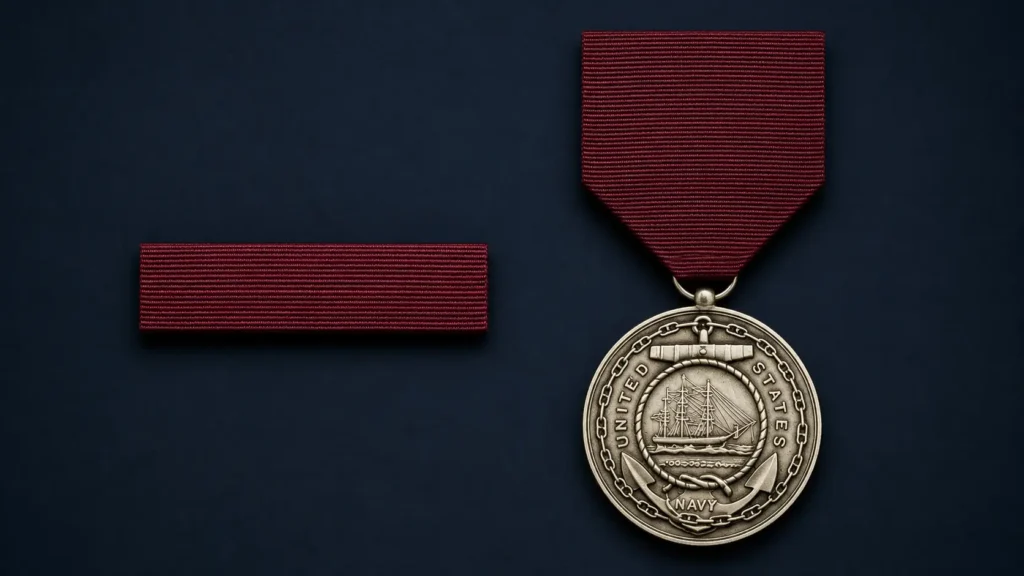
Very few awards in the sea services say as much about a Sailor as the Good Conduct Medal that Navy leaders have handed out since 1869. It does not mark one brave afternoon. It marks three straight years of showing up, doing the work, and keeping a clean record. Shipmates notice that. So do the people who read a rack.
Quick Answer: The Navy Good Conduct Medal is awarded to enlisted Sailors who complete three consecutive years of honorable and faithful active service with a clean disciplinary record. The ribbon is solid red. A bronze 3/16 inch star marks each award after the first, and one silver star replaces five bronze stars.
What Is the Navy Good Conduct Medal?
The Navy Good Conduct Medal is the oldest good conduct award in the United States military. The Navy established it on 26 April 1869, decades before the Army, Marine Corps, Coast Guard, or Air Force created their own versions.
The award honors steady, faithful service rather than a single act. A Sailor earns it by doing the daily job well over a long stretch of time. That is a different kind of achievement than a valor award, and the Navy has always treated it as its own category of recognition.
The reverse of the medal carries three words: FIDELITY ZEAL OBEDIENCE. Those words have stayed with the award through every design change since the 1800s, and they still describe what the medal is meant to recognize.
The very first version, issued in 1869, was a nickel Maltese cross. By the 1880s, the Navy moved to the bronze planchet shape that Sailors would recognize today. The ring suspension used on the modern medal arrived in 1961.
Which Instruction Sets the Good Conduct Medal Navy Criteria?
The governing authority is SECNAVINST 1650.1J, the Secretary of the Navy Instruction on Navy and Marine Corps awards, along with its companion manual SECNAV M-1650.1. The instruction states the policy. The manual holds the detailed criteria, and that is where the three-year rule and the disqualifying conduct language live.
Executive Orders 8809, 9323, and 10444 also appear in the medal’s authority chain, dating back to the periods when the award’s terms were adjusted by presidential action.
If you ever need to settle a disagreement about eligibility, the manual is the document to cite. Your command career counselor or personnel office can pull the current version for you. Blogs and forums are helpful for orientation, but the manual is the source of truth.
Who Is Eligible for the Good Conduct Medal in the Navy?
Eligibility rests on four simple points.
You must be enlisted. Officers do not receive the Navy Good Conduct Medal. This has been true since 1869. An officer who earned the medal as an enlisted Sailor keeps it and continues to wear it, which is why you sometimes see it on an officer’s rack.
You must complete three continuous years of active service. The three-year period must run without a break and without a disqualifying event inside it.
Your record must be clean for the whole period. A single qualifying infraction inside the window stops the clock, which we cover in the next section.
Here is a point that trips people up. The three-year requirement is current, but it has not always been the standard. From 1869 until 1 November 1963, the Navy required four years. Awards falling between 1 November 1963 and 1 January 1996 also carried a four-year requirement. The three-year rule took effect on 1 January 1996 and applies to service from that date forward.
So if you are helping a father or grandfather sort out an older record, check the dates before you assume three years. The answer may well be four.
What Conduct Resets the Three-Year Clock?
This is the part Sailors ask about most.
Any non-judicial punishment, disciplinary infraction, or court-martial conviction inside the qualifying window resets the clock. The three years start over from the date of the incident. Time already served toward the award does not carry forward.
That rule sounds strict, and it is. It is also the reason the medal carries weight. A Sailor wearing three or four stars on that red ribbon has kept a clean record across nine or twelve years, and everyone who reads a rack understands what that took.
A few notes that soften the picture a little. Not every negative entry counts as disqualifying. Commands treat minor counseling, a poor evaluation mark, or an administrative remark differently from formal punishment. Your command makes the eligibility determination, and there is a process for review if you believe a decision was made in error. If your situation sits in a gray area, ask your chief or your personnel office to look at the manual language with you rather than assuming the worst.
What Does the Navy Good Conduct Medal Ribbon Look Like?
The modern Navy Good Conduct ribbon is solid red. No stripes, no edges of another color, just a clean red field. Among the many striped ribbons on a Navy rack, that plain red block is easy to spot from across a room.

The design was not always this simple. The original ribbon was half an inch wide and carried red, white, and blue. The Navy moved to the all-red design later, and that version has been standard for generations.
The medal itself hangs from the same red ribbon and shows a bronze planchet with the FIDELITY ZEAL OBEDIENCE inscription on the reverse.
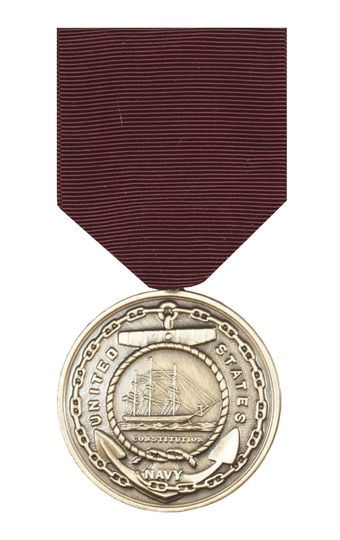
If you are ordering a replacement or building a new rack, the solid red ribbon is easy to identify but also easy to confuse with other services’ good conduct ribbons at a glance. The Army version, for example, carries red with white edge stripes. When you are shopping, check the branch label rather than going by color memory alone.
Where Does It Sit in the Navy Order of Precedence?
Precedence tells you where a ribbon goes on your rack. On the Navy list, the Good Conduct Medal sits in the service and campaign group, below personal decorations and below unit awards.
The two neighbors are worth memorizing.
| Position | Award |
| Immediately before | Armed Forces Honor Medal |
| The award | Navy Good Conduct Medal |
| Immediately after | Naval Reserve Meritorious Service Medal |
Unit awards such as the Navy Unit Commendation and the Meritorious Unit Commendation sit well above the Good Conduct Medal, in an earlier category entirely. That surprises some Sailors who assume a personal award always outranks a unit award. On the Navy list, unit awards come first.
For the full sequence from the Medal of Honor down through service and training ribbons, see our Navy ribbon order of precedence guide. It lays the whole list out in order so you can check your rack row by row.
How Do Bronze and Silver Stars Show Second and Later Awards?
The Navy uses 3/16 inch stars to mark additional awards. The rule is straightforward once you see it laid out.
| What you see | What it means | Total awards |
| Plain red ribbon, no device | First award | 1 |
| One bronze star | Second award | 2 |
| Two bronze stars | Third award | 3 |
| Three bronze stars | Fourth award | 4 |
| Four bronze stars | Fifth award | 5 |
| One silver star | Sixth award | 6 |
| One silver, one bronze | Seventh award | 7 |
The pattern is simple. The ribbon alone is the first award. Each bronze star after that adds one. When you reach the point where you would wear five bronze stars, a single silver star replaces all five. You then continue adding bronze stars alongside the silver.
Here is a contrast worth knowing. The Army handles the same idea in a completely different way. Instead of stars, the Army Good Conduct Medal uses clasps with knots: a bronze clasp for the second through fifth awards, silver for the sixth through tenth, and gold for the eleventh through fifteenth, with the number of knots on the clasp showing the exact count.
| Service | Device used | How later awards are shown |
| Navy | 3/16 inch stars | Bronze star per award, silver star replaces five bronze |
| Army | Clasps with knots | Bronze, silver, then gold clasps; knots show the count |
So a Sailor and a Soldier with the same number of good conduct awards will have racks that look nothing alike at that ribbon. If you are helping a family member sort a mixed service collection, that difference matters. Our Army Good Conduct Medal guide walks through the clasp and knot system in full.
Navy Good Conduct Medal or Naval Reserve Meritorious Service Medal?
For decades, the Navy ran two parallel awards, and this is a common point of confusion for Reserve Sailors and their families.
The Navy created the Naval Reserve Meritorious Service Medal in 1962, made it retroactive to 1958, and issued it to enlisted Reserve Sailors. It required four years of qualifying service until 1996, then three years after that, mirroring the active duty timeline.
| Feature | Navy Good Conduct Medal | Naval Reserve Meritorious Service Medal |
| Who received it | Enlisted, active service | Enlisted, Naval Reserve |
| Created | 1869 | 1962, retroactive to 1958 |
| Period required | 4 years, then 3 years from 1996 | 4 years, then 3 years from 1996 |
| Status today | Active award | Discontinued in 2014 |
On 1 January 2014, Navy Reserve enlisted Sailors became eligible for the Navy Good Conduct Medal itself, and a Secretary of the Navy directive ended the Naval Reserve Meritorious Service Medal. From that date forward, there is one good conduct award for enlisted Sailors, Reserve and active alike.
One more detail for full-time support Sailors. Those serving in the TAR program always received the Navy Good Conduct Medal rather than the Reserve award, because their service was full-time active duty.
If a Sailor earned the Reserve medal before 2014, it remains a valid award and is still worn. The 2014 change did not erase anything. It simply stopped new issues and unified the path going forward.
How Do You Check Your Own Record, Step by Step?
If you are not sure how many awards you hold, or whether a period counted, here is a practical path.
Step one. Pull your service record. Active duty Sailors can request it through their personnel office or command career counselor. Veterans can request records through the National Personnel Records Center.
Step two. Look for your DD Form 214 if you have separated. Block 13 lists decorations, medals, badges, and campaign ribbons. The Good Conduct Medal and the number of awards should appear there.
Step three. Count the award periods, not the years. If you served nine clean years, you likely hold three awards, which means the ribbon plus two bronze stars. Check the dates against the four-year rule if any of that service falls before 1996.
Step four. If something looks wrong, ask your personnel office to review it against SECNAV M-1650.1. Corrections are possible, and records from older periods sometimes have gaps that a review can fix.
Step five. Once you know your count, build your rack correctly the first time. Getting the device count right matters as much as getting the ribbon right.
Build Your Navy Rack the Easy Way
Once you know what you have earned, putting it on your uniform should be the simple part.
Our navy ribbon rack builder lets you pick your ribbons, set them in the correct order of precedence, and add your devices without guesswork. The tool arranges the rows for you, so you are not counting positions by hand or second-guessing whether the Good Conduct Medal goes above or below the ribbon next to it.
You can also browse our full range of Navy ribbons if you know exactly what you need and just want to order individual pieces.
Not sure where to start? Our guide on how to build a Navy ribbon rack walks through the process from first ribbon to finished mount.
Ready to get it done? Build my ribbon rack Navy style now →
Use code STR2025 at checkout for 10% off your order.
Built in the USA, Trusted by Sailors Nationwide
We make every ribbon and rack right here in the United States. We keep our ultra-thin profile because a slim rack sits flat and clean on the uniform, and because Sailors told us that is what they wanted.
Super Thin Ribbons is a U.S.-based company, headquartered at 1602 Loop 11, Wichita Falls, Texas 76306. You can reach our team directly at 940-851-6220 or sa***@**************ns.com.
If you are ever unsure about a device count or a precedence question, call us. We would rather spend five minutes on the phone with you than have you wear something that is not quite right.
Frequently Asked Questions
Three continuous years of honorable and faithful active service, effective 1 January 1996. Before that date the requirement was four years.
You must be enlisted, complete three continuous years of active service, maintain honorable and faithful conduct throughout, and hold a record free of non-judicial punishment or court-martial conviction during that period.
A single bronze 3/16 inch star on the ribbon marks the second award. The ribbon alone represents the first.
The Navy uses one bronze star. The Army uses a bronze clasp with one knot. The device systems are not interchangeable, so always match the device to the branch.
No. The award is for enlisted Sailors only. An officer who earned it while enlisted keeps it and continues to wear it.
No. It resets the three-year clock from the date of the incident. You can still earn the award by completing three clean years from that point.
Solid red, with no stripes. The original 1869 version was red, white, and blue, but the all-red design has been standard for generations.
Yes. Navy Reserve enlisted Sailors became eligible on 1 January 2014, the same date the Navy ended the Naval Reserve Meritorious Service Medal.
It falls after the Armed Forces Honor Medal and before the Naval Reserve Meritorious Service Medal, within the service and campaign award group.
SECNAVINST 1650.1J and the companion manual SECNAV M-1650.1 govern Navy and Marine Corps awards, including good conduct criteria.
Thank you for your service. The Good Conduct Medal is not the flashiest award on a rack, but it is one of the most honest. It says you did the job, day after day, for years, and you did it right. We are proud to help you wear it the way it deserves to be worn.