


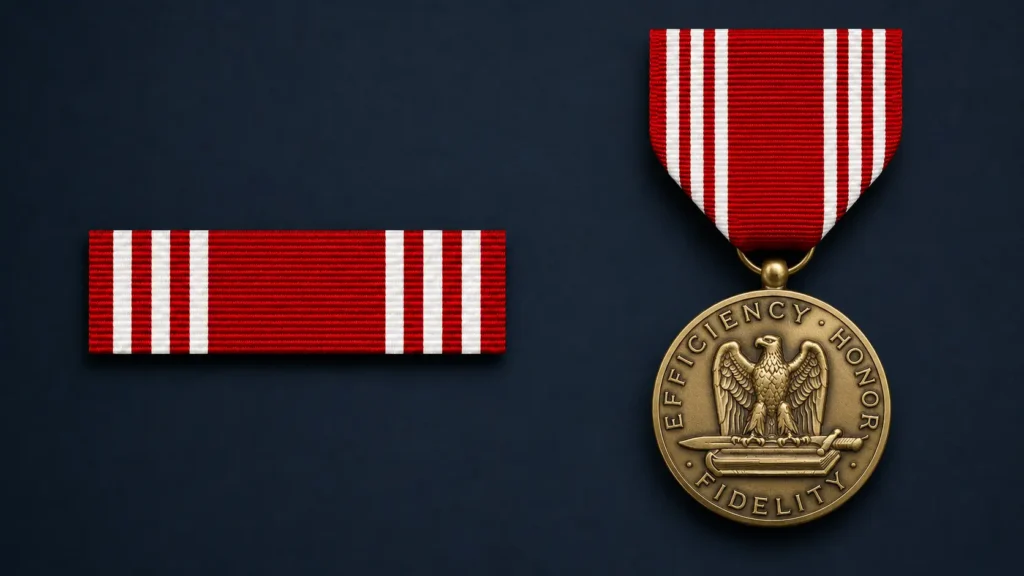
Few awards say as much about a soldier’s daily character as the Good Conduct Medal. Army leaders do not hand it out for a single moment of courage. They award it for three quiet years of showing up, doing the job well, and staying true to the standard. If you are checking whether you qualify, or helping a soldier in your formation understand the rules, this guide walks through it gently and in plain language.
Quick Answer: The Army Good Conduct Medal recognizes enlisted soldiers for exemplary behavior, efficiency, and fidelity across three years of continuous active federal military service. AR 600-8-22 sets the criteria. A soldier needs ratings of excellent or higher in character and efficiency, a recommendation from the immediate commander, and no conviction by court-martial during the qualifying period. The ribbon is scarlet with three narrow white stripes at each edge, and clasps with knots mark second and later awards.
What Is the Army Good Conduct Medal?
President Franklin D. Roosevelt established this award on June 28, 1941, through Executive Order 8809. Later orders, Executive Order 9323 in 1943 and Executive Order 10444 in 1953, refined who could receive it. The purpose has stayed the same ever since. The Army wanted a way to honor enlisted soldiers whose everyday conduct set the example for everyone around them.
The three words on the front of the medal say it best: efficiency, honor, and fidelity. Those are not qualities a soldier earns in one afternoon. They build over years of steady service, and this award exists to recognize exactly that.
Many soldiers wear several of these medals throughout their careers. Each one represents another full period of service completed the right way.
Which Regulation Sets the Good Conduct Medal Army Criteria?
AR 600-8-22, Military Awards, governs this medal, along with every other Army decoration, service medal, and ribbon. It defines who qualifies, what counts as a qualifying period, and what stops the clock.
The same regulation sets the order in which you wear your ribbons. Our companion guide on the Army ribbon order of precedence under AR 600-8-22 walks through that full sequence, in case you want to see how this medal fits alongside the rest of your rack.
Your unit S-1 shop remains your best local resource. They hold your records and can confirm your qualifying dates for you.
Who Is Eligible for the Good Conduct Medal in the Army?
The Army sets a clear list of requirements. A soldier qualifies when all of the following are true:
- You serve as an enlisted soldier. Officers do not earn this award. The Army designed it specifically for the enlisted force.
- You complete three years of continuous active federal military service. The service must be honorable and faithful throughout the full period.
- You hold ratings of excellent or higher in both character and efficiency for that period.
- Your immediate commander recommends you without reservation.
- You have no conviction by court-martial during the qualifying period.
A few situations allow a first award in less than three years. Soldiers who served one year of continuous active service during a declared period of war may qualify for a first award. So may soldiers whose service ended because of a service-connected disability incurred in the line of duty, and soldiers who died in the line of duty before completing the full period.
These shorter periods carry specific date ranges and conditions. Please ask your S-1 to verify your own situation against the current regulation before you assume either way.
What Conduct Can Delay or Disqualify the Award?
This is the part that worries soldiers most, so let us take it slowly and kindly.
A conviction by court-martial ends the qualifying period. The clock does not pause. It starts over. A soldier can still earn the medal afterward by completing a fresh three-year period that meets every requirement.
Nonjudicial punishment under Article 15 does not automatically disqualify you. This surprises many people. Your immediate commander reviews your record as a whole and decides whether your service still reflects the standard the award represents. One entry in a long and otherwise strong record does not always end the matter.
The commander’s recommendation carries real weight. The Army trusts the leader who sees your work every day to judge whether your conduct and efficiency truly set the example.
If you believe you qualify and no recommendation has come through, a respectful conversation with your chain of command is a reasonable first step. Records sometimes lag behind reality, and many awards get corrected once someone simply asks.
What Does the Army Good Conduct Medal Ribbon Look Like?
The ribbon is scarlet, with three narrow white stripes at each edge. Those stripes divide the ribbon into thirteen sections, one for each of the thirteen original colonies. Arthur E. DuBois of the Army Institute of Heraldry designed it, and the color choice carries its own quiet history. Scarlet recalled Britain during the Revolutionary War, while white stood for the newly independent American land.
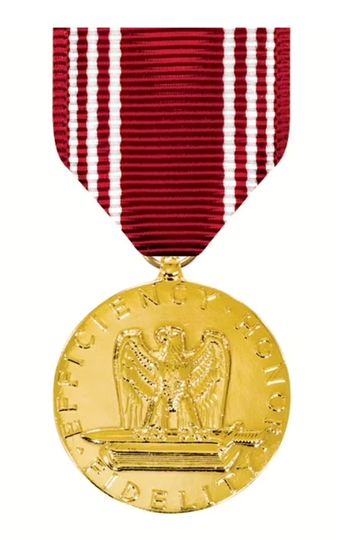
The medal itself, designed by sculptor Joseph Kiselewski, shows an eagle standing on a Roman sword laid across a closed book. The eagle represents vigilance. The sword represents loyalty and readiness. The book represents knowledge. The words EFFICIENCY, HONOR, FIDELITY curve around the design.
Turn the medal over, and you will find a five-pointed star above a blank scroll, left open so a recipient’s name can be engraved. The words FOR GOOD sit above the star, and CONDUCT sits below the scroll. A wreath of laurel and oak leaves surrounds it all. Laurel stands for accomplishment, and oak stands for bravery.
You can see the ribbon alongside every other Army award in our Army ribbons catalog, arranged in official precedence order.
Where Does the Good Conduct Medal Sit in the Army Order of Precedence?
The Good Conduct Medal sits at an easy-to-remember spot. It falls just after the Prisoner of War Medal, which closes out the personal military decorations, and just before the campaign and service medals.
The sequence around it runs like this:
- Personal military decorations, ending with the Prisoner of War Medal
- Army Good Conduct Medal
- Good conduct medals from other branches, for soldiers with prior service elsewhere
- Army Reserve Components Achievement Medal
- Campaign and service medals, starting with the National Defense Service Medal
So on your rack, the Good Conduct Medal marks the boundary between what you earned personally and what you earned by serving during a particular period. That makes it a helpful landmark when you check your own arrangement.
How Do Clasps and Knots Show Second and Later Awards?
Here is the detail that trips up more soldiers than any other, and it is worth slowing down for. The Army does not use oak leaf clusters on this medal. It uses clasps with knots, sometimes called loops, and the counting method changes as you move up.
| Total awards earned | Device worn on the ribbon |
| 1st award | No device. The ribbon alone. |
| 2nd through 5th awards | Bronze clasp with two through five knots |
| 6th through 10th awards | Silver clasp with one through five knots |
| 11th through 15th awards | Gold clasp with one through five knots |
Read it this way, and it becomes simple:
- Bronze counts directly. The number of knots equals the number of medals. Three knots on a bronze clasp means three awards.
- Silver starts at five. Add the knots. A silver clasp with two knots means seven awards.
- Gold starts at ten. Add the knots. A gold clasp with three knots means thirteen awards.
A soldier with a gold clasp has served well past thirty years of qualifying enlisted service. That is a remarkable career, and the device on the ribbon deserves to be right.
Not sure which clasp your record supports? Count your total awards first. Then match that number to the table above. When you order, choose the device that reflects your full career, not only your most recent award.
Good Conduct Medal or Reserve Components Achievement Medal?
Soldiers in the Army National Guard and Army Reserve often ask which award applies to them. These are two separate medals, and they’re easy to mix up because both honor steady, exemplary service.
| Points | Army Good Conduct Medal | Army Reserve Components Achievement Medal |
| Who earns it | Enlisted soldiers on active federal service, including AGR enlisted soldiers | Soldiers in the grade of colonel and below serving in ARNG or USAR troop program units, and individual mobilization augmentees. AGR officers also qualify. |
| Qualifying period | Three years of continuous active federal service | Three years of qualifying reserve service since March 28, 1995. Four years applied before that date. |
| Officers eligible | No | Yes |
| Later awards shown by | Clasps with knots | Oak leaf clusters |
| Governing regulation | AR 600-8-22 | AR 600-8-22 |
The short version is simple. Active federal service points toward the Good Conduct Medal. Troop program unit service points toward the Reserve Components Achievement Medal. A soldier with both kinds of service may well wear both medals.
How Do You Check Your Own Record, Step by Step?
Whenever a new award posts, or you prepare for an inspection, this short check helps:
- Pull your record. Active-duty soldiers can review their awards in their official military personnel file through their S-1. Veterans can check the awards block on their DD-214.
- Count your Good Conduct Medal awards. Look for every qualifying period, not just the most recent one.
- Match your total to the clasp table above. Confirm the clasp color and the knot count together.
- Check the precedence position. The medal belongs after your personal decorations and before your campaign and service medals.
- Rebuild the rack. Mount everything in the correct sequence, or let our rack builder arrange it for you automatically.
Would you like the full picture? Our step-by-step walkthrough on how to build an Army ribbon rack covers rows, spacing, and mounting in more detail.
Build Your Army Rack the Easy Way
You do not need to hold the whole precedence chart. Our Build Your Rack tool already carries the current Army order of precedence for every award, including the Good Conduct Medal and its clasps. Select the ribbons you earned, add your devices, and we mount your rack thin, aligned, and ready to wear.
Build Your Army Ribbon Rack now →
Use code STR2025 at checkout for 10% off your order.
Built in the USA, Trusted by Soldiers Nationwide
Super Thin Ribbons is a U.S.-based company, headquartered at 1602 Loop 11, Wichita Falls, Texas 76306. You can reach our team directly at 940-851-6220 or sa***@**************ns.com. We design, build, and ship every rack from our Texas facility, using Institute of Heraldry-approved materials, for soldiers, veterans, and their families across the United States.
Frequently Asked Questions
A soldier must serve three years of continuous active federal military service as an enlisted member. That soldier also needs ratings of excellent or higher in character and efficiency, plus a recommendation from the immediate commander. No conviction by court-martial may fall inside the period. AR 600-8-22 sets these criteria.
No. The Army awards this medal to enlisted soldiers only. Officers in the Army National Guard and Army Reserve may instead qualify for the Army Reserve Components Achievement Medal.
Not automatically. Nonjudicial punishment goes into your record, and your immediate commander weighs it when deciding whether to recommend you. A conviction by court-martial, however, ends the qualifying period, and a new three-year period must begin.
There is no practical limit across a full career. The Army recognizes each qualifying period with a clasp on the ribbon, and the regulation charts devices through a fifteenth award.
Each knot helps show how many awards a soldier has earned. A bronze clasp carries two through five knots for the second through fifth awards. A silver clasp carries one through five knots for the sixth through tenth awards. A gold clasp carries one through five knots for the eleventh through fifteenth awards.
The ribbon is scarlet with three narrow white stripes at each edge. Those stripes divide the ribbon into thirteen sections, one for each of the thirteen original colonies.
It sits after the Prisoner of War Medal, which ends the personal decorations. It comes before the campaign and service medals, such as the National Defense Service Medal.
In limited cases, yes. One year of continuous active service during a declared period of war may support a first award. So may separation for a service-connected disability incurred in the line of duty. Death in the line of duty also qualifies. Ask your S-1 to confirm your specific dates.
To every soldier, veteran, and retiree wearing this ribbon: thank you for your service, and for the years of steady conduct it represents. We are honored to help you display it correctly.