


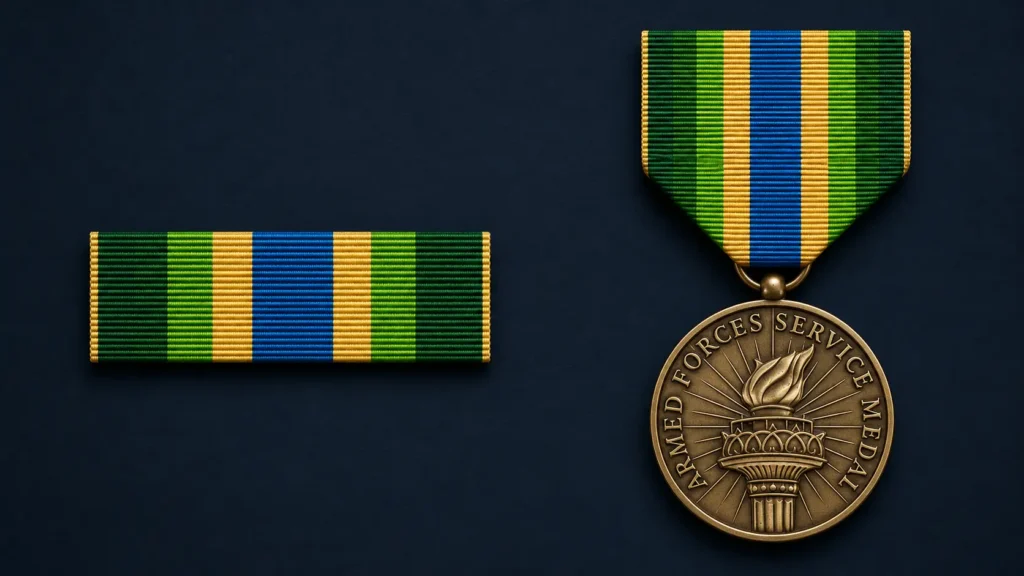
Some of the most demanding assignments in American military history carried no enemy fire. Service members held a line in the Balkans, flew relief into a famine, sealed a border, or stood up a hospital in the middle of an outbreak. The work was hard, the conditions were poor, and no shot was ever fired at them.
The Armed Forces Service Medal exists to recognize precisely that service. It fills a gap that had gone unfilled for decades, and it is worth understanding correctly.
Quick Answer: The Armed Forces Service Medal recognizes members of the Armed Forces who take part in a designated U.S. military operation where they face no foreign armed opposition and no imminent hostile action, and where no other campaign or service medal is authorized. It was established by Executive Order 12985 on 11 January 1996 and applies retroactively to 1 June 1992. It sits immediately before the Humanitarian Service Medal in the order of precedence.
What Is the Armed Forces Service Medal?
President Clinton established the Armed Forces Service Medal by Executive Order 12985, signed on 11 January 1996. The award dates back to 1 June 1992.
Its purpose is specific. Before the AFSM existed, a service member could deploy for months into a difficult and consequential operation and receive no medal at all, simply because the operation involved no combat. The Armed Forces Expeditionary Medal covered operations with hostile action. Nothing covered operations without it.
The AFSM closed that gap. It recognizes participation in significant military activity conducted below the threshold of armed conflict, including peacekeeping, humanitarian relief, disaster response, and support to civil authorities.
The design carries the point. The obverse shows a demi-torch, the torch held by the Statue of Liberty, with rays radiating from behind it. The reverse bears the eagle from the Department of Defense seal within a laurel wreath, above the inscription IN PURSUIT OF DEMOCRACY.
Who Is Eligible for the Armed Forces Service Medal?
Eligibility rests on three conditions, and all three must hold.
First, the operation must be a designated one. The Department of Defense approves each operation individually and maintains the official list. Service in an undesignated operation does not qualify, however difficult that service was.
Second, the member must meet the participation standard. Any one of the following satisfies it:
- Bona fide membership in a unit participating in the operation for one or more days within the designated area of eligibility
- Direct support to the operation for 30 consecutive days in the area of eligibility, or 60 non-consecutive days involving entry into that area
- Regular assignment as a crew member on aircraft flying into, out of, within, or over the area of eligibility in support of the operation
Third, the operation must have involved no foreign armed opposition and no imminent threat of hostile action. This is the defining condition of the award, and it is the one that separates the AFSM from the Armed Forces Expeditionary Medal.
Two exclusions apply. The medal is not authorized for national or international training exercises. It is not awarded for an operation in which the Armed Forces Expeditionary Medal has been approved, with a narrow exception granted for Operations Joint Endeavor and Joint Guard.
When Does the Armed Forces Expeditionary Medal Apply Instead?
This distinction accounts for most of the confusion around the AFSM, so it deserves a direct statement.
| Condition | Armed Forces Service Medal | Armed Forces Expeditionary Medal |
| Foreign armed opposition | None | Present or imminent |
| Nature of the operation | Peacekeeping, relief, support | Expeditionary, hostile environment |
| Awarded together | Only for Joint Endeavor and Joint Guard | Only for Joint Endeavor and Joint Guard |
The two medals cover the same idea at different thresholds. One recognizes presence and contribution in a designated operation. The other recognizes the same in an environment where hostile action was a real prospect. A member does not choose between them. The Department of Defense designates which medal applies to each operation.
Which Operations Qualify for the AFSM?
The Department of Defense maintains the authoritative list and revises it as new operations are approved. The following are among the recognized operations, grouped by era.
| Period | Operation | Area |
| 1992 to 2004 | Provide Promise, Deny Flight, Sharp Guard, Able Sentry, Joint Endeavor, Joint Guard, Joint Forge | Former Yugoslavia, the Adriatic, Macedonia, Italy, Hungary |
| 1995 to 2000 | United Nations Mission in Haiti | Haiti |
| 2005 to 2006 | Hurricane Katrina and Hurricane Rita relief | U.S. Gulf Coast |
| 2006 to 2008 | Operation Jump Start | Southwest border of the United States |
| 2010 | Operation Unified Response | Haiti |
| 2014 to 2015 | Operation United Assistance | West Africa, Ebola response |
| 2020 to 2023 | COVID-19 response | Domestic |
| 2021 to 2022 | Operation Allies Refuge and Operation Allies Welcome | Afghanistan and domestic |
This table is representative rather than exhaustive, and area of eligibility boundaries and inclusive dates are defined precisely in the DoD list. Any member verifying entitlement should consult the current DoD-approved operations document or their servicing personnel office. Dates and boundaries decide the matter, not general recollection of a deployment.
Where Does the AFSM Fall in the Order of Precedence?
The Armed Forces Service Medal sits within the service and campaign group, below personal decorations and unit awards.
| Position | Award |
| Immediately before | Korea Defense Service Medal |
| The award | Armed Forces Service Medal |
| Immediately after | Humanitarian Service Medal |
The relationship to the Humanitarian Service Medal is worth holding in mind, because the two are adjacent on the rack and frequently confused. A single deployment can result in both, since they recognize different things. The AFSM recognizes participation in a designated military operation. The Humanitarian Service Medal recognizes meritorious direct participation in a specific humanitarian act or operation.
Each branch publishes its own complete precedence list. For the full sequence, see our order of precedence guides for the Army, Navy, Air Force, Marine Corps, Coast Guard, and Space Force.
What Does the Armed Forces Service Medal Ribbon Look Like?
The ribbon is one and three-eighths inches wide. Reading from the outside edge toward the center, it carries golden light, jungle green, green, and moss tone green, with a bluebird stripe of one-quarter inch at the center.

The greens and the golden light edges give the ribbon a distinctive appearance on a rack, and the single blue center stripe makes it straightforward to identify at a glance. It is not easily mistaken for anything else in the service and campaign group.
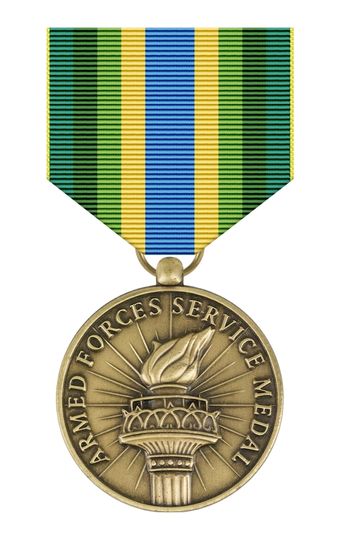
The medal itself is bronze and measures one and a quarter inches in diameter.
How Are Second and Later Awards Shown?
Each additional qualifying operation is recognized with a bronze service star, worn on both the suspension ribbon of the medal and the service ribbon.
A silver service star replaces five bronze service stars.
The distinction matters here. The star marks a separate designated operation, not additional time within the same one. A member who served eighteen months in one operation holds one award. A member who served in three separate designated operations wears two bronze stars.
AFSM, NDSM, or Humanitarian Service Medal?
These three are the most commonly confused awards in this part of the rack. The comparison is short.
| Award | What it recognizes |
| Armed Forces Service Medal | Participation in a designated military operation with no foreign armed opposition |
| National Defense Service Medal | Honorable active service during a designated period of national emergency |
| Humanitarian Service Medal | Meritorious direct participation in a specific humanitarian act or operation |
The National Defense Service Medal turns on when a member served. The AFSM turns on for which operation. The Humanitarian Service Medal turns on what the member did during it. A single career can carry all three.
Our companion guide covers the National Defense Service Medal in full.
Placing It Correctly on Your Rack
Once entitlement is confirmed, the remaining task is placement, and placement is where a correct record can still be displayed incorrectly.
Our ribbon rack builder arranges your awards in the correct order of precedence for your branch and accounts for service stars and other devices. You may also browse ribbons by branch: Army, Navy, Air Force, Marine Corps, Coast Guard, and Space Force.
Use code STR2025 for 10% off your order.
Frequently Asked Questions
Participation in a designated U.S. military operation in which the member encountered no foreign armed opposition or imminent hostile action, and for which no other campaign or service medal is authorized.
Membership in a participating unit for one or more days in the area of eligibility, or 30 consecutive or 60 non-consecutive days in direct support, or regular assignment as aircrew flying in support of the operation.
By Executive Order 12985 on 11 January 1996, retroactive to 1 June 1992.
The NDSM recognizes honorable service during a designated national emergency period. The AFSM recognizes participation in a specific designated operation. They are separate awards and may both be held.
Not for the same operation, except for Operations Joint Endeavor and Joint Guard, where a specific exception applies.
By a bronze service star for each additional designated operation. A silver service star replaces five bronze.
The DoD approved list includes the COVID-19 response for the period running from 31 January 2020. Entitlement still depends on meeting the participation standard within the defined area and dates.
Immediately after the Korea Defense Service Medal and immediately before the Humanitarian Service Medal.
To every service member who deployed into a hard place and came home without a campaign to name for it, this medal is your record. It was created because that service deserved acknowledgment, and it deserves to be worn correctly.
Super Thin Ribbons is a U.S.-based company, headquartered at 1602 Loop 11, Wichita Falls, Texas 76306. You can reach our team directly at 940-851-6220 or sa***@**************ns.com.