


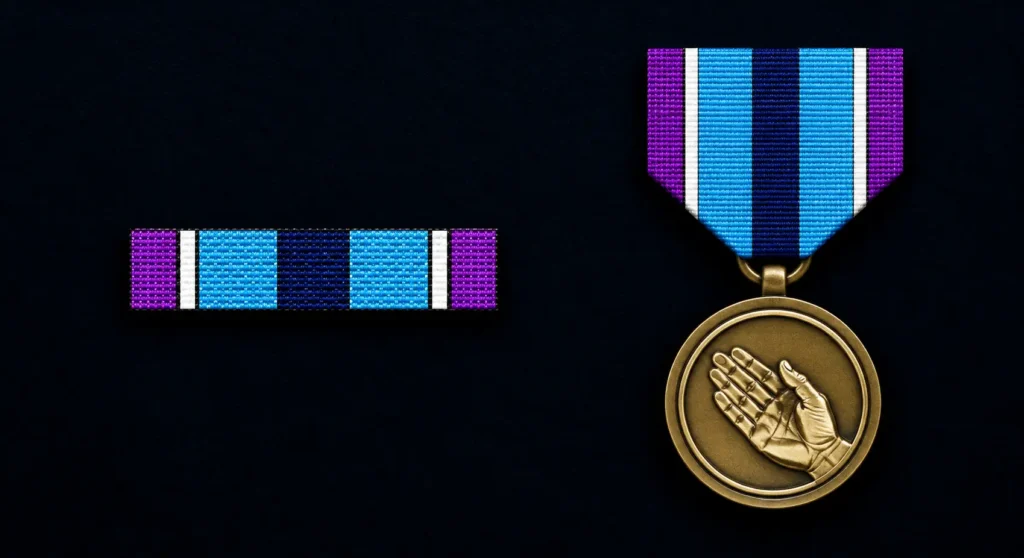
The Humanitarian Service Medal may be the most commonly earned and least often claimed award.
A lot of that comes down to how it arrives. Nobody recommends you for it the way a commander recommends a commendation. A unit deploys after an earthquake, the work gets done, and everyone goes home. Paperwork catches up months later, often after people have moved to a new assignment. So the rack gets built without it. Then, years later, someone reads the criteria and realizes the medal was theirs all along.
Quick Answer: The Humanitarian Service Medal recognizes anyone who took direct, hands-on part in a Department of Defense-designated humanitarian operation while physically present at the site. Executive Order 11965 created it on 19 January 1977, and it covers qualifying service from 1 April 1975 onward. It sits below the Armed Forces Service Medal and above the Military Outstanding Volunteer Service Medal. A bronze service star marks each award after the first.
Where the Medal Came From
President Gerald R. Ford signed Executive Order 11965 on 19 January 1977, one day before leaving office. The order recognized those who, in its words, “distinguished themselves by meritorious participation in a military act or operation of a humanitarian nature.”
The timing was deliberate. Eligibility reaches back to 1 April 1975, which places the evacuation of Southeast Asia inside the window. Operation Frequent Wind, Operation New Life, and Operation Babylift all fall within it. So a lot of people who flew or sailed those operations qualify, and plenty of them never knew it.
This is a Department of Defense award rather than a service one. The same medal therefore crosses all six branches, while each branch governs the wear under its own regulation. Army criteria appear in 32 CFR 578.35 and AR 600-8-22.
Who Actually Qualifies
Here is the rule that decides almost every case, and it is stricter than people expect.
The regulation requires direct participation, defined as hands-on activity at the site of the operation. You had to be there. Anyone who supported the mission from a geographically separated headquarters falls outside the criteria, no matter how hard they worked or how much the operation leaned on them.
Two further conditions apply.
The operation must be designated. The Department of Defense approves each qualifying act or operation by name. Helping after a disaster is admirable, yet it earns this medal only when the operation appears on the approved list. Your awards branch holds the current list.
You must fall within the geography and the dates. Each designated operation carries a defined area and a defined window. Show up a week late, or work just outside the boundary, and the criteria no longer reach you, even when the work was identical.
None of this is meant to be stingy. The narrowness is the point. This medal says its wearer stood on the ground, doing the work, where people needed help.
Three Awards People Confuse
Most of the confusion in the awards system lives here. Three medals sound as though they cover similar ground, and they do not.
| Award | What it recognizes | The deciding test |
| Armed Forces Service Medal | Participation in a designated military operation that is not combat, often in support of US, NATO, or UN aims | Were you deployed on a designated non-combat operation? |
| Humanitarian Service Medal | Hands-on participation in a designated humanitarian operation, at the site | Were you physically there, doing the work? |
| Military Outstanding Volunteer Service Medal | Sustained volunteer service to the civilian community, on your own time | Was it off duty, and separate from your official duties? |
The short version runs like this. Deployment earns the Armed Forces Service Medal. Hands earn the Humanitarian Service Medal. Free time earns the Military Outstanding Volunteer Service Medal. Sorting out the first of those? Our guide to the Armed Forces Service Medal covers its criteria in full.
Where It Sits on the Rack
Precedence here is settled and easy to remember.
The Armed Forces Service Medal sits immediately above. The Military Outstanding Volunteer Service Medal sits immediately below. Put the Humanitarian Service Medal between those two and the rest falls into place.
That order holds across every branch, though the awards around it will differ depending on what else you hold. Our branch guides lay out the full sequence: Army, Navy, Air Force, Marine Corps, Coast Guard, and Space Force.
What the Ribbon and Medal Look Like
The ribbon is 1 3/8 inches wide. Working in from each edge, it runs imperial purple, a narrow white stripe, bluebird, then flag blue at the center. Each color carries meaning: purple for self-sacrifice, white for regeneration, blue for universal friendship.

The medal is bronze, 1 1/4 inches across. Its obverse carries an open right hand, palm forward and angled upward, which is about as plain a symbol of giving as heraldry gets. On the reverse, FOR HUMANITARIAN SERVICE runs across three lines above an oak branch, ringed by UNITED STATES ARMED FORCES.
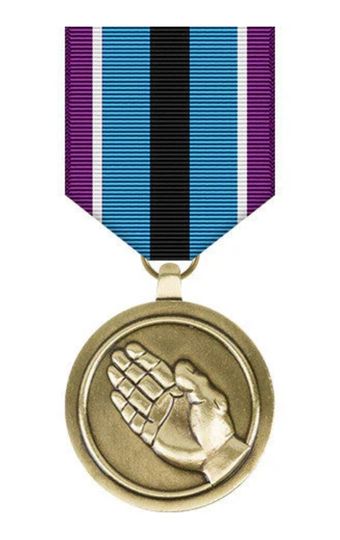
Adding it to a rack? We stock the Humanitarian Service Medal ribbon in stock at $2.05, alongside the full-size medal for ceremony and formal wear. We make both here in Texas and mount them ready to wear.
Second and Subsequent Awards
A bronze service star on the ribbon and the suspension ribbon denotes each award after the first. So one star means two operations, two stars mean three, and so on.
At the fifth award, the arithmetic changes. A silver service star replaces five bronze ones, which keeps a long record readable rather than crowding the ribbon.
Device counts remain the most common mistake we see on finished racks. Check yours twice against your record before ordering.
If You Earned It and Never Received It
This happens often enough to be worth saying plainly.
Start with your DD Form 214, block 13, which lists decorations, medals, badges, and campaign ribbons. If the medal is missing but you served on a designated operation, your branch awards branch can review the record. The National Personnel Records Center can also help track down paperwork that went missing over the years.
After that, wearing it is simple. Veterans keep the right to wear what they earned, and our guide to wearing medals on civilian clothes explains how.
Add It to Your Rack
Our ribbon rack builder places this medal in the correct order of precedence for your branch and handles the service stars. Count and sequence come out right before we mount anything.
You can also browse our full range of military medals.
Use code STR2025 for 10% off your order.
Built in the USA
Super Thin Ribbons is a U.S.-based company, headquartered at 1602 Loop 11, Wichita Falls, Texas 76306. You can reach our team directly at 940-851-6220 or sa***@**************ns.com.
We also update racks originally bought from us. Adding this medal to a set you already own does not mean replacing the whole rack, so call us, and we will walk you through it.
Frequently Asked Questions
Members of the Armed Forces, including Reserve Components, who took direct hands-on part in a Department of Defense-designated humanitarian operation while present at the site. Service on or after 1 April 1975 qualifies.
No. The regulation excludes personnel at geographically separated locations who made no direct contribution at the site. Presence and hands-on work decide it.
Directly below the Armed Forces Service Medal and directly above the Military Outstanding Volunteer Service Medal.
A bronze service star for each award after the first. A silver service star replaces five bronze stars.
The Humanitarian Service Medal recognizes official duty on a designated operation. The other recognizes sustained volunteer work in the civilian community, done on your own time, separate from assigned duties.
Yes. Check block 13 of your DD Form 214, then ask your branch awards branch to review the record. The National Personnel Records Center can help if the paperwork is missing.
Thank You
The open hand on the obverse was a good choice. It records something quieter than valor, and the people who were there are often proudest of exactly this one.
If you wore this medal, you were on the ground somewhere after a storm, an earthquake, or an evacuation, doing work that most people only ever see on the news. Thank you for going. Thank you for the hours nobody counted and the ones nobody wrote down.
And thank you for reading this far. If anything here is unclear, or you are not certain what belongs on your rack, please call us at 940-851-6220. We would rather talk it through with you than have you guess.
Regulations referenced: Executive Order 11965, 32 CFR 578.35, AR 600-8-22, and DAFI 36-2803.