


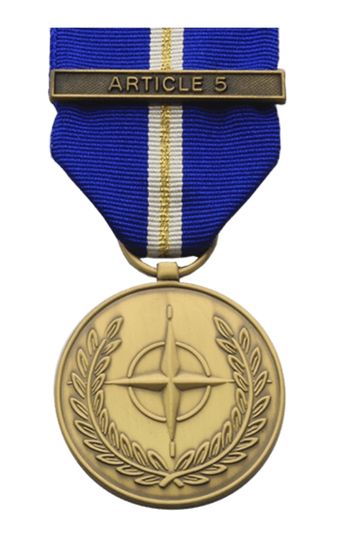
A Medal Rooted in NATO’s Response to 9/11
When the North Atlantic Council invoked Article 5 of the Washington Treaty for the first time in NATO’s history following the attacks of September 11, 2001, it triggered Operation Eagle Assist, a NATO-led mission to help the United States secure and control North American airspace. The Article 5 NATO Medal for Operation Eagle Assist was created to recognize the alliance personnel who made that mission possible.
Operation Eagle Assist ran from October 12, 2001, to May 16, 2002, with NATO AWACS aircraft deploying to the United States and operating within NORAD-designated airspace. It was a historic moment: Allied nations stepping directly onto US soil to defend American skies.
What Makes This Medal Unique for US Recipients
US service members who earned this medal have a specific wear rule that sets it apart from how other NATO allies display it. While NATO issues the Eagle Assist medal with an “Eagle Assist” clasp (bar) on the ribbon, US military personnel are not authorized to wear the bar on their uniform. The bar may be accepted and kept as a personal keepsake, but only the basic medal and ribbon are worn on the uniform in accordance with DoD regulations.
If you have been awarded more than one NATO medal for service in different operations, a bronze service star is affixed to the suspension ribbon and service ribbon in place of wearing multiple NATO medals; only one NATO ribbon is ever worn at a time on a US uniform.